Nanny Goat (late 200s BCE): Art, History and Details
Nanny Goat at the Cleveland Museum of Art: late 200s BCE, bronze. Explore the work's context, creator attribution and collection history.
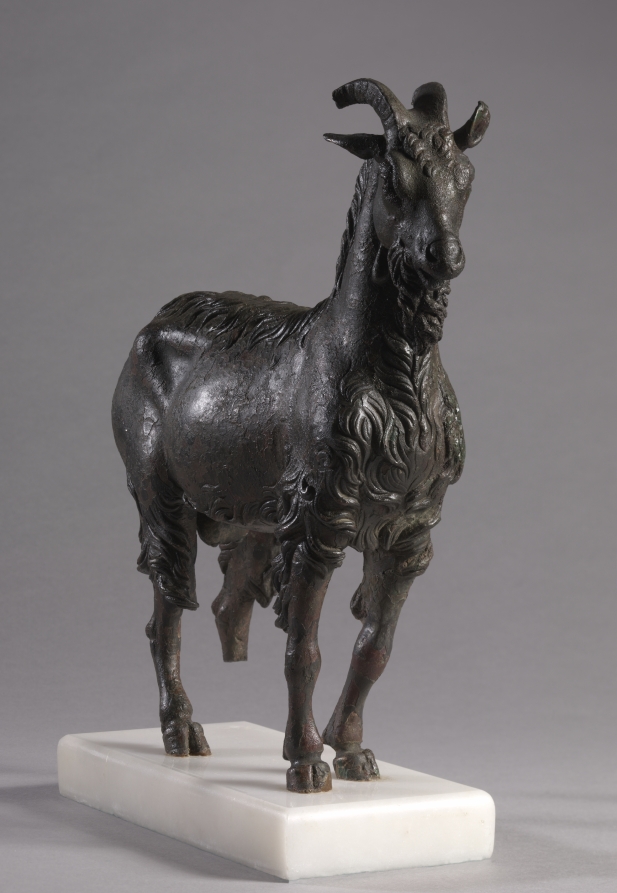
Nanny Goat (late 200s BCE) is in the Cleveland Museum of Art collection.
The work and its context
The museum's open-access catalogue describes the work:
Goats were among the earliest domesticated animals and figured prominently in Greek art and mythology since at least the 8th century BC. This example with its powerful stance, curly beard, and horns is not a ram but an expecting doe with swollen flanks. The subject is rare and its meaning unclear. Possibly she was part of a group dedication to a goddess. The sunken areas at the tail and hips and her open mouth, indicating heavy breathing, are signs that she is ready to give birth.
Object facts
- Title: Nanny Goat
- Date: late 200s BCE
- Culture: Greece, Hellenistic period
- Type: Sculpture
- Technique: bronze
- Dimensions: Overall: 30.5 x 31.1 cm (12 x 12 1/4 in.)
- Collection: GR - Greek
- Department: Greek and Roman Art
- Accession number: 1990.32
A detail from the museum
This sculpture depicts a pregnant goat, which is extremely rare.
Collection credit
Leonard C. Hanna Jr. Fund
Further reading listed by the museum
- The Cleveland Museum of Art. Handbook of the Cleveland Museum of Art. Cleveland, OH: The Cleveland Museum of Art, 1991.
- Kozloff, Ariellé P. "Notable Acquisitions." The Bulletin of the Cleveland Museum of Art 78, no. 3 (1991): 63-147.
- Cleveland Museum of Art. The CMA Companion: A Guide to the Cleveland Museum of Art. Cleveland: Cleveland Museum of Art, 2014.
View the collection record
See the museum's photographs and full catalogue entry. Catalogue text is reproduced from the Cleveland Museum of Art's open-access data, with HTML formatting removed. This object and its supplied image are designated CC0.
Sources
More in Lifestyle
Keep reading