Oculate Being Mask (300 BCE–1 CE (thermoluminescence date, 835 BC–185 CE)): Art, History and Details
Oculate Being Mask at the Cleveland Museum of Art: 300 BCE–1 CE (thermoluminescence date, 835 BC–185 CE), ceramic, resin-based paint. Explore the work's context, creator attribution and collection history.
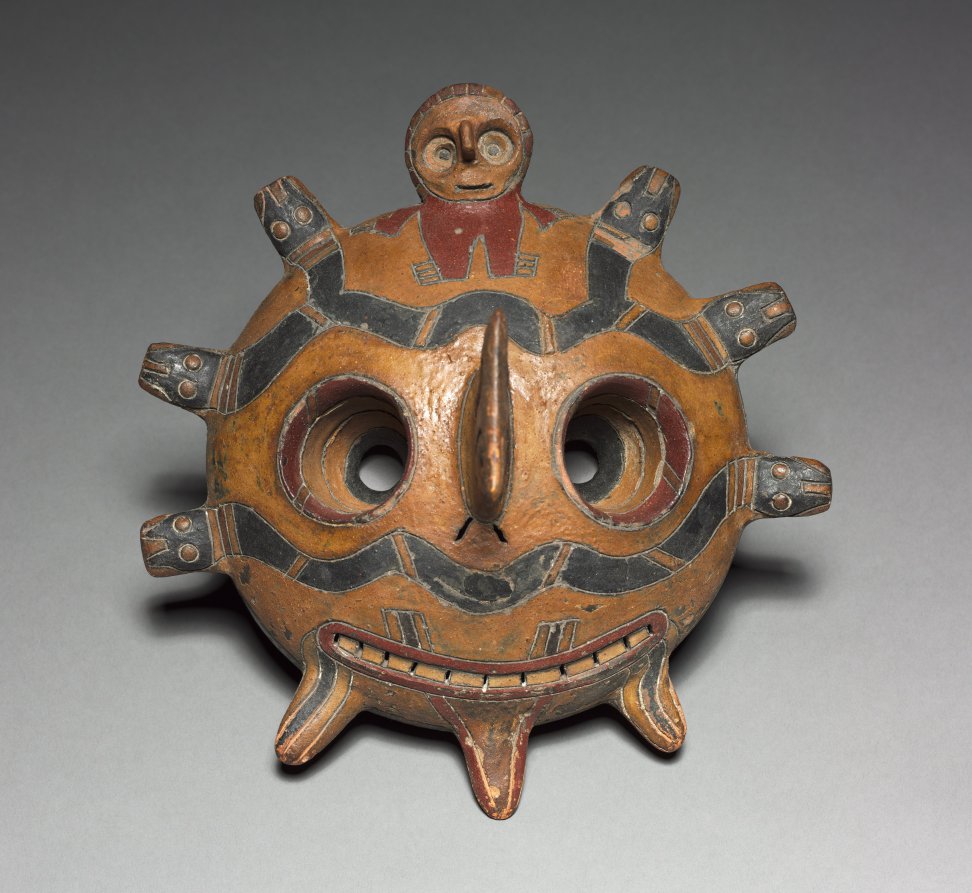
Oculate Being Mask (300 BCE–1 CE (thermoluminescence date, 835 BC–185 CE)) is in the Cleveland Museum of Art collection.
The work and its context
The museum's open-access catalogue describes the work:
This rare mask incarnates a supernatural being who may have been the patron of an early fertility cult on Peru’s south coast. Its traits insinuate power, especially the stuck-out tongue and the serpents that slither over the face to form a halo-like corona. Unexplained are the shape of the nose and the small figure wearing a similar mask. The mask could have served as the face of a mummy bundle or an object; the projecting eyes might rule out use by a living performer.
Object facts
- Title: Oculate Being Mask
- Date: 300 BCE–1 CE (thermoluminescence date, 835 BC–185 CE)
- Culture: Peru, South Coast, Paracas (Cavernas) style (700 BCE–1 CE)
- Type: Ceramic
- Technique: ceramic, resin-based paint
- Dimensions: Overall: 23.6 x 22.5 x 13.2 cm (9 5/16 x 8 7/8 x 5 3/16 in.)
- Collection: AA - Andes
- Department: Art of the Americas
- Accession number: 2003.39
Collection credit
Purchase from the J. H. Wade Fund
Further reading listed by the museum
- Bergh, Susan E., "Ancient Eyes", Cleveland Museum of Art. Cleveland Art: The Cleveland Museum of Art Members Magazine. Vol. 44 no. 06, Summer 2004
- Cleveland Museum of Art. Cleveland Art: The Cleveland Museum of Art Members Magazine. Vol. 53 no. 03, May/June 2013
View the collection record
See the museum's photographs and full catalogue entry. Catalogue text is reproduced from the Cleveland Museum of Art's open-access data, with HTML formatting removed. This object and its supplied image are designated CC0.
Sources
More in Lifestyle
Keep reading