Ornamental Shoulder Bands from a Tunic (500s): Art, History and Details
Ornamental Shoulder Bands from a Tunic at the Cleveland Museum of Art: 500s, tapestry weave with supplementary weft wrapping; undyed linen and dyed wool. Explore the work's context, creator attribution and collection history.
Ornamental Shoulder Bands from a Tunic (500s) is in the Cleveland Museum of Art collection.
The work and its context
The museum's open-access catalogue describes the work:
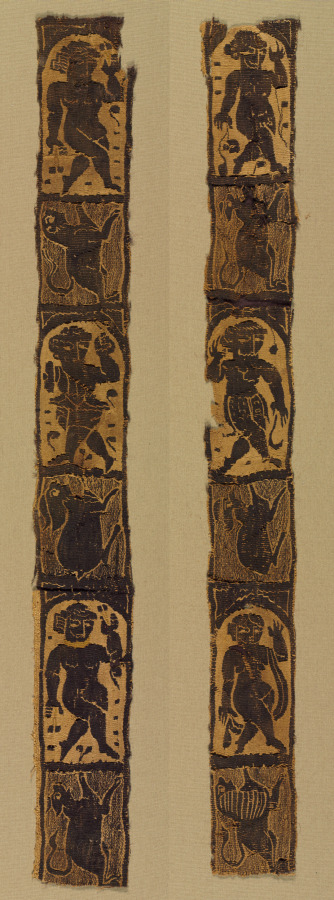
This fragment shows human figures including dancers, a hunter, and shepherd under arches alternating with animals such as dogs, rabbits, and a lion. The orientation of the figures indicates that these vertical bands were once part of a tunic. The decorative bands would have descended from the shoulders. Since the mid-3rd century tunics were the main garments worn in Egypt which was then part of the Roman Empire.
Object facts
- Title: Ornamental Shoulder Bands from a Tunic
- Date: 500s
- Culture: Egypt, Byzantine period
- Type: Textile
- Technique: tapestry weave with supplementary weft wrapping; undyed linen and dyed wool
- Dimensions: Average: 7 x 43.5 cm (2 3/4 x 17 1/8 in.)
- Collection: T - Coptic
- Department: Textiles
- Accession number: 1926.145
A detail from the museum
One band contains a nude female dancer playing finger cymbals while the other shows a shepherd carrying a crook and dressed in a skirt of animal skin.
Collection credit
Gift of George D. Pratt
View the collection record
See the museum's photographs and full catalogue entry. Catalogue text is reproduced from the Cleveland Museum of Art's open-access data, with HTML formatting removed. This object and its supplied image are designated CC0.
Sources
More in Lifestyle
Keep reading