Oud (late 1800s–early 1900s): Art, History and Details
Oud at the Cleveland Museum of Art: late 1800s–early 1900s, Wood, gut, and metal. Explore the work's context, creator attribution and collection history.
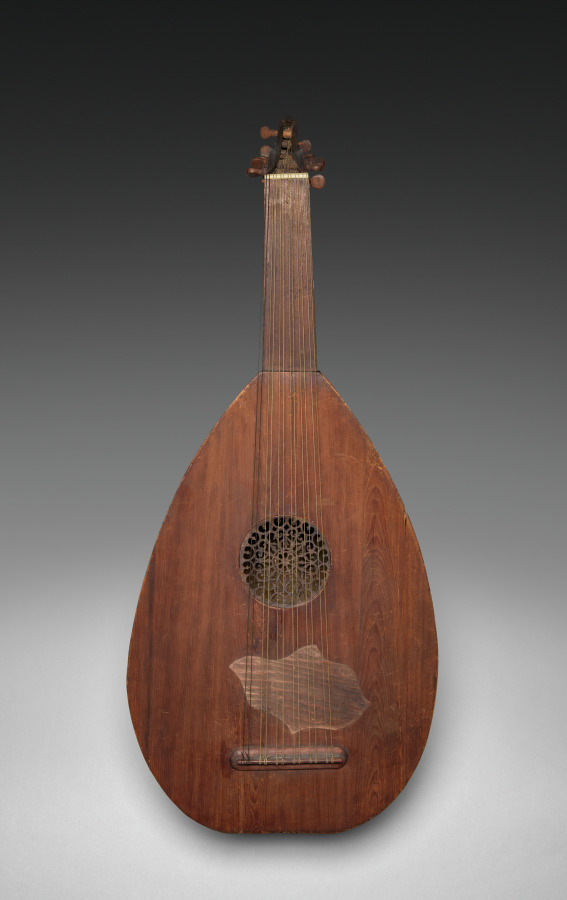
Oud (late 1800s–early 1900s) is in the Cleveland Museum of Art collection.
The work and its context
The museum's open-access catalogue describes the work:
A member of the lute family, there is perhaps no more emblematic instrument of the Islamic world than the oud. It provided music for banquets and gatherings, accompanied poets, punctuated celebrations and festivals, and is still prominent today. The oud is included in the medieval philosopher al-Farabi’s (872–950/951) Great Book of Music (Kitab al-Musiqa al-Kabir) in which he discusses the modal system of Arabic music. The defining characteristics of an oud are evident here: a pear-shaped body with a fretless fingerboard and a peg box set at a 45-to-90-degree angle to the neck.
Object facts
- Title: Oud
- Date: late 1800s–early 1900s
- Culture: West Asia
- Type: Musical Instrument
- Technique: Wood, gut, and metal
- Dimensions: Overall: 81.3 x 33.7 cm (32 x 13 1/4 in.)
- Collection: Islamic Art
- Department: Islamic Art
- Accession number: 1918.350
A detail from the museum
The oud has influenced music traditions throughout the world by becoming the European lute, the Chinese pipa, and the Indonesian qanbūs.
Collection credit
The Charles G. King Jr. collection; Gift of Ralph King in memory of Charles G. King Jr.
Further reading listed by the museum
- "Accessions." The Bulletin of the Cleveland Museum of Art 5, no. 8/9 (1918): 82-85.
- D. S. M. "Exhibition of Musical Instruments." The Bulletin of the Cleveland Museum of Art 8, no. 9 (1921): 134-43.
View the collection record
See the museum's photographs and full catalogue entry. Catalogue text is reproduced from the Cleveland Museum of Art's open-access data, with HTML formatting removed. This object and its supplied image are designated CC0.
Sources
More in Lifestyle
Keep reading