Page from Tales of a Parrot (Tuti-nama): text page (c. 1560): Art, History and Details
Page from Tales of a Parrot (Tuti-nama): text page at the Cleveland Museum of Art: c. 1560, gum tempera, ink, and gold on paper. Explore the work's context, creator attribution and collection history.
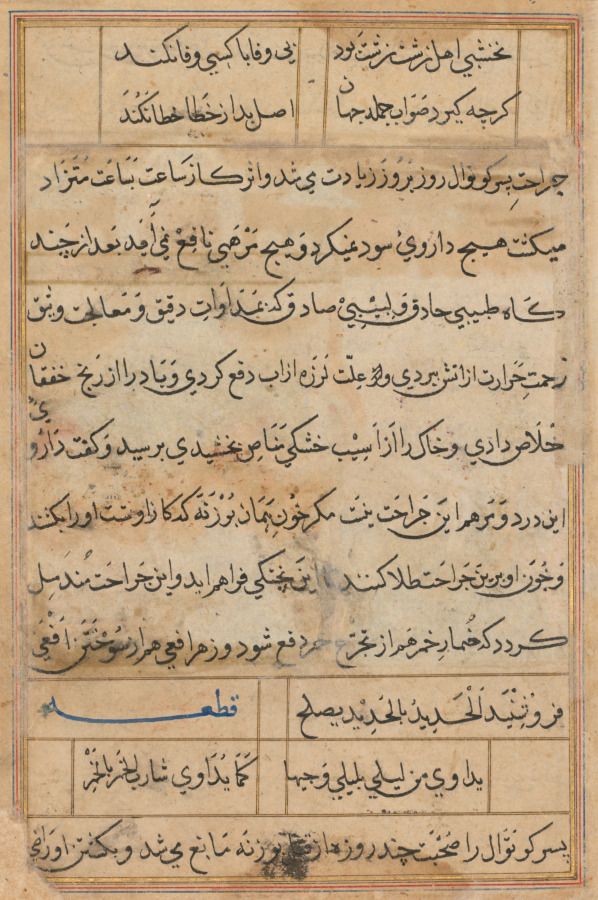
Page from Tales of a Parrot (Tuti-nama): text page (c. 1560) is in the Cleveland Museum of Art collection.
The work and its context
The museum's open-access catalogue describes the work:
The book of the Tuti-nama from which this page comes consists of 341 folios, or 682 pages. The 52 tales told by the parrot Tuti to his mistress Khujasta and the overarching frame story about Khujasta herself are all written in Persian. Here the form of the script is called naskh and is read from right to left. The word in blue means “cut,” which indicates that the prose narrative will cut to a poetic verse. The Tuti-nama was written in 1329–30 by a Persian-speaking Sufi scholar and author from Central Asia. He based it on an earlier Persian work that recast a collection of Sanskrit fables from ancient India and other Persian tales. The blending of cultures and ethnicities long pre-dated the Mughals in India.
Object facts
- Title: Page from Tales of a Parrot (Tuti-nama): text page
- Date: c. 1560
- Culture: Mughal India, court of Akbar (reigned 1556–1605)
- Type: Painting
- Technique: gum tempera, ink, and gold on paper
- Dimensions: Overall: 20.3 x 14 cm (8 x 5 1/2 in.)
- Collection: Indian Art
- Department: Indian and Southeast Asian Art
- Accession number: 1962.279.33.a
A detail from the museum
The Tuti-nama illustrations were painted mainly by Indian artists, though the manuscript is in in a Persian book format.
Collection credit
Gift of Mrs. A. Dean Perry
View the collection record
See the museum's photographs and full catalogue entry. Catalogue text is reproduced from the Cleveland Museum of Art's open-access data, with HTML formatting removed. This object and its supplied image are designated CC0.
Sources
More in Lifestyle
Keep reading