Page from the Panj Ganj (Five Treasures) of Abd al-Rahman Jami (Persian, 1414–1492), with two Persian masnavis (narrative poems): Yusuf va Zulaykha (Joseph and Zulaykha) and Subhat al-abrar (Rosary of
Page from the Panj Ganj (Five Treasures) of Abd al-Rahman Jami (Persian, 1414–1492), with two Persian masnavis (narrative poems): Yusuf va Zulaykha (Joseph and Zulaykha) and Subhat al-abrar (Rosary of the Righteous) at the Cleveland Museum
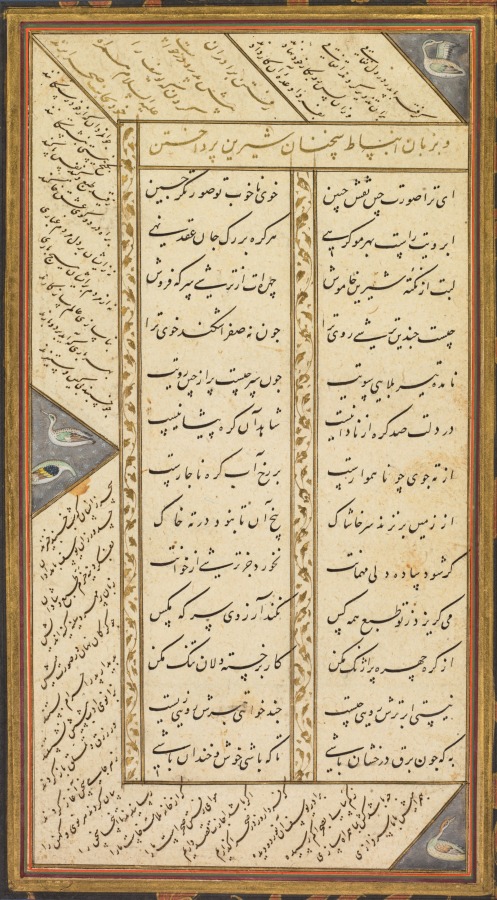
Page from the Panj Ganj (Five Treasures) of Abd al-Rahman Jami (Persian, 1414–1492), with two Persian masnavis (narrative poems): Yusuf va Zulaykha (Joseph and Zulaykha) and Subhat al-abrar (Rosary of the Righteous) (Text c. 1500–1520; painting, borders, and illuminations added 1603–7 Text copied by Sultan-Ali Mashhadi (Persian, active early 1500s) for Badi al-Zaman Mirza, ruler of Herat Painted insets and borders by Mushfiq (Indian, active 1580s–early 1600s) Text copied in Herat Painting, borders, and illuminations made in the Deccan for Mughal minister Abd al-Rahim the Khan Khanan) is in the Cleveland Museum of Art collection. The museum's creator attribution is Mushfiq (Indian, active early 1600s); others (Indian).
The work and its context
The museum's open-access catalogue describes the work:
The recto of this album page contains two different texts, one written diagonally in the border and the other in the two central columns. The section of poetry in the border describes an episode from Joseph’s childhood in which his older brothers suggest to Jacob, their father, that they take Joseph into the countryside so that the boy can learn the area, although they actually plan to kill him. The poem in the central columns advises the reader to smile often, as a smile is sweeter and more pleasing than sugar. This page is from a prized manuscript owned by one of the most respected statesmen of the imperial Mughal court, Abd al-Rahim. He served as the Khan Khanan, or vizier, the trusted minister under both Akbar and Jahangir. Abd al-Rahim was an avid book collector and patron of the arts. He acquired this book of five extended narrative poems, which included the story told in rhyme of the romance between Joseph and the Egyptian lady Zulaykha, about 80 years after its completion. The book’s illumination had not been finished, so Abd al-Rahim commissioned the exuberant decor of the borders and insets along with full-page paintings that illustrate key scenes in the text.
Object facts
- Title: Page from the Panj Ganj (Five Treasures) of Abd al-Rahman Jami (Persian, 1414–1492), with two Persian masnavis (narrative poems): Yusuf va Zulaykha (Joseph and Zulaykha) and Subhat al-abrar (Rosary of the Righteous)
- Date: Text c. 1500–1520; painting, borders, and illuminations added 1603–7 Text copied by Sultan-Ali Mashhadi (Persian, active early 1500s) for Badi al-Zaman Mirza, ruler of Herat Painted insets and borders by Mushfiq (Indian, active 1580s–early 1600s) Text copied in Herat Painting, borders, and illuminations made in the Deccan for Mughal minister Abd al-Rahim the Khan Khanan
- Creator attribution: Mushfiq (Indian, active early 1600s); others (Indian)
- Culture: Northern India, Mughal, early 17th century
- Type: Painting
- Technique: Gum tempera, ink, and gold on paper
- Collection: Indian Art - Mughal
- Department: Indian and Southeast Asian Art
- Accession number: 2013.315.2
A detail from the museum
The bearded goat in a rocky landscape evokes what Joseph might see on his outing.
Collection credit
Gift in honor of Madeline Neves Clapp; Gift of Mrs. Henry White Cannon by exchange; Bequest of Louise T. Cooper; Leonard C. Hanna Jr. Fund; From the Catherine and Ralph Benkaim Collection
View the collection record
See the museum's photographs and full catalogue entry. Catalogue text is reproduced from the Cleveland Museum of Art's open-access data, with HTML formatting removed. This object and its supplied image are designated CC0.
Sources
- Page from the Panj Ganj (Five Treasures) of Abd al-Rahman Jami (Persian, 1414–1492), with two Persian masnavis (narrative poems): Yusuf va Zulaykha (Joseph and Zulaykha) and Subhat al-abrar (Rosary of the Righteous) (Text c. 1500–1520; painting, borders, and illuminations added 1603–7 Text copied by Sultan-Ali Mashhadi (Persian, active early 1500s) for Badi al-Zaman Mirza, ruler of Herat Painted insets and borders by Mushfiq (Indian, active 1580s–early 1600s) Text copied in Herat Painting, borders, and illuminations made in the Deccan for Mughal minister Abd al-Rahim the Khan Khanan; Cleveland 2013.315.2) — Cleveland Museum of Art
- Cleveland Museum of Art Open Access
More in Lifestyle
Keep reading