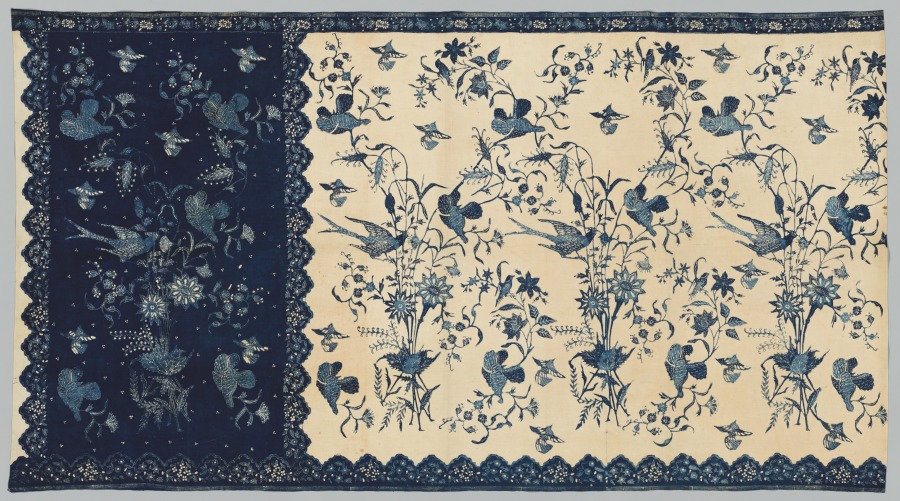
Panel of Chintz for a Woman's Skirt (1730-50): Artwork and History
Panel of Chintz for a Woman's Skirt at the Art Institute of Chicago: date, artist attribution, materials and the museum's explanation of the work.

Panel of Chintz for a Woman's Skirt (1730-50) is in the Art Institute of Chicago collection. The museum lists its creator attribution as Made in India possibly for the Dutch or Latin American market.
The work and its context
The Art Institute of Chicago describes the work:
Starting in the early 1600s Portuguese traders brought Indian hand-dyed fabrics to Europe, where the Hindi name for them, chint, became chintz. During this same period, Spanish conquests in the Western Hemisphere led to direct trade between Asia and the Americas. This lively patterned chintz displays scrolls and flowers typical of a European design vocabulary as well as tiny scenes of animals and hunters. It exemplifies the creative designs that captivated global consumers and may have been made for the Dutch market, although it could equally have been worn by a woman in New Spain in the 1700s.
Object facts
- Title: Panel of Chintz for a Woman's Skirt
- Date: 1730-50
- Artist attribution: Made in India possibly for the Dutch or Latin American market
- Place of origin: India
- Medium: Cotton, plain weave; hand painted and dyed
- Dimensions: 363.9 × 113.7 cm (143 1/4 × 44 3/4 in.)
- Type: Textile
- Department: Textiles
- Reference number: 1922.5569
Collection credit
Gift of Van Ry and Ter Gast for the Hibbard Dutch Room
View the original
Explore the artwork in the Art Institute's collection, including its image and the museum's current catalogue details.
The description above is credited to the Art Institute of Chicago and reused under Creative Commons Attribution 4.0; HTML formatting has been converted to plain text. Other catalogue metadata and the public-domain image are provided under CC0 1.0.
Sources
More in Lifestyle
Keep reading