Parrot (c. 1910): Art, History and Details
Parrot at the Cleveland Museum of Art: c. 1910, earthenware with lustre glazes. Explore the work's context, creator attribution and collection history.
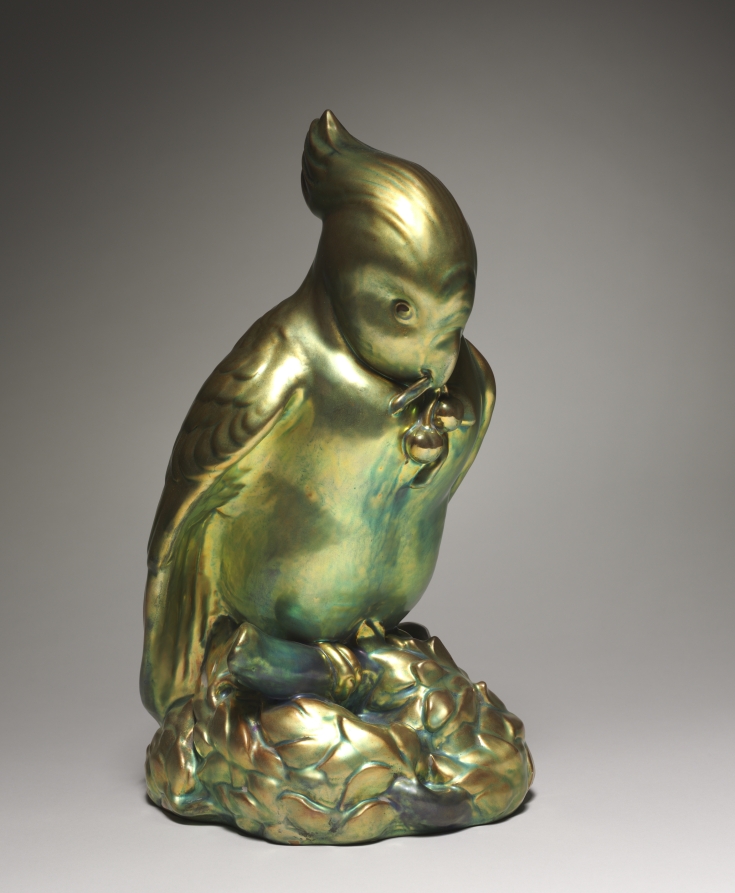
Parrot (c. 1910) is in the Cleveland Museum of Art collection. The museum's creator attribution is Zsolnay Factory (Hungarian).
The work and its context
The museum's open-access catalogue describes the work:
This parrot's distinctive metallic sheen is achieved through a technique known as luster glazing, in which ground metals, typically silver, gold, or platinum, are incorporated into the glazing process. The parrot is decorated with green-gold luster, while the base is decorated with blue-purple-gold luster.
Object facts
- Title: Parrot
- Date: c. 1910
- Creator attribution: Zsolnay Factory (Hungarian)
- Culture: Hungary
- Type: Ceramic
- Technique: earthenware with lustre glazes
- Dimensions: Overall: 38.3 x 26.7 x 19.9 cm (15 1/16 x 10 1/2 x 7 13/16 in.)
- Collection: Decorative Arts
- Department: Decorative Art and Design
- Accession number: 1984.190
A detail from the museum
The glaze technique on this parrot is eosin, which takes its name from Eos, the Greek goddess of dawn.
Collection credit
Gift in memory of Mrs. Magda Nàdasy, from her estate
Further reading listed by the museum
- Turner, Evan H. “The Year in Review for 1984.” The Bulletin of the Cleveland Museum of Art 72, no. 2 (April 1985): 163–207.
View the collection record
See the museum's photographs and full catalogue entry. Catalogue text is reproduced from the Cleveland Museum of Art's open-access data, with HTML formatting removed. This object and its supplied image are designated CC0.
Sources
More in Lifestyle
Keep reading