Pectoral (Chest Ornament) (1–800 CE): Art, History and Details
Pectoral (Chest Ornament) at the Cleveland Museum of Art: 1–800 CE, gold, hammered. Explore the work's context, creator attribution and collection history.
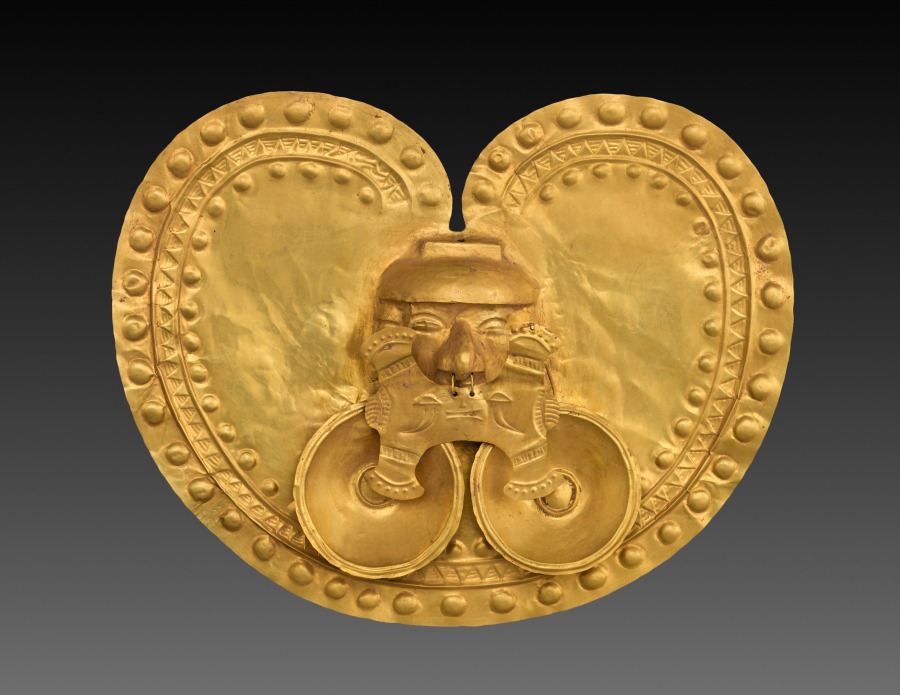
Pectoral (Chest Ornament) (1–800 CE) is in the Cleveland Museum of Art collection.
The work and its context
The museum's open-access catalogue describes the work:
Bilobed pectorals are some of the most flamboyant objects created by artists in Colombia’s Calima region. Chiefs apparently wore such pectorals—among the largest torso adornments ever created in the ancient Americas—with other gold objects, including bracelets, dramatic headdress adornments, and ear and nose ornaments like those shown on the pectoral itself. Thus, they armored themselves in gold, which likely had complex symbolism; for instance, it may have been associated with the sun and thereby with nourishing cosmic energies and positive moral behavior.
Object facts
- Title: Pectoral (Chest Ornament)
- Date: 1–800 CE
- Culture: Isthmian Region (Colombia), Calima, Yotoco period
- Type: Metalwork
- Technique: gold, hammered
- Dimensions: Overall: 22.7 x 28.5 x 2.9 cm (8 15/16 x 11 1/4 x 1 1/8 in.)
- Collection: AA - Intermediate Region
- Department: Art of the Americas
- Accession number: 2015.2
A detail from the museum
Calima bilobed pectorals are among the largest torso ornaments ever made in the ancient Americas.
Collection credit
Severance and Greta Millikin Purchase Fund
Further reading listed by the museum
- Cleveland Museum of Art. Museum Masters: 2016-17 Companion Guide. [Cleveland, Ohio]: Cleveland Museum of Art, 2016.
- Bergh, Susan E. “Acquisitions 2015: Pre-Columbian and Native North American Art.” Cleveland Art: Cleveland Museum of Art Members Magazine 56, no. 2 (March/April 2016): 32-33.
- Griswold, William M. "Recent Acquisitions (2013-20) at the Cleveland Museum of Art," The Burlington Magazine 163, no. 1414 (January 2021): 93-104.
View the collection record
See the museum's photographs and full catalogue entry. Catalogue text is reproduced from the Cleveland Museum of Art's open-access data, with HTML formatting removed. This object and its supplied image are designated CC0.
Sources
More in Lifestyle
Keep reading