Peonies and Rocks (early 1900s): Art, History and Details
Peonies and Rocks at the Cleveland Museum of Art: early 1900s, Six-panel folding screen; ink and color on silk. Explore the work's context, creator attribution and collection history.
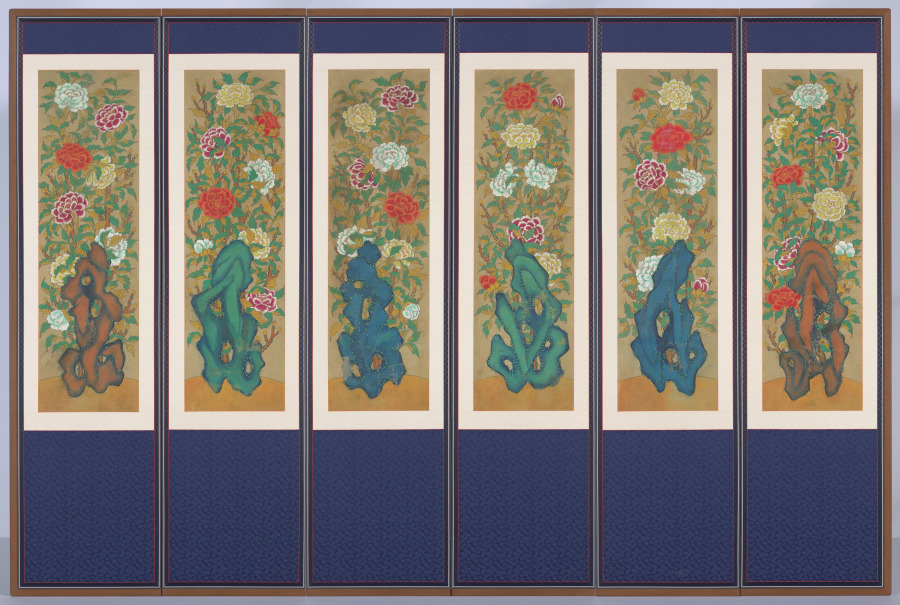
Peonies and Rocks (early 1900s) is in the Cleveland Museum of Art collection.
The work and its context
The museum's open-access catalogue describes the work:
By the late nineteenth century, peony paintings with bold designs and striking graphic stylization were increasingly produced and consumed by middle-class members because of its symbolic meaning: prosperity and wealth.
Object facts
- Title: Peonies and Rocks
- Date: early 1900s
- Culture: Korea, Joseon dynasty (1392−1910) or Japanese colonial period (1910−1945)
- Type: Painting
- Technique: Six-panel folding screen; ink and color on silk
- Dimensions: Overall: 175.8 x 264.6 cm (69 3/16 x 104 3/16 in.); Painting: 104.7 x 30.8 cm (41 1/4 x 12 1/8 in.)
- Collection: ASIAN - Folding screen
- Department: Korean Art
- Accession number: 2022.60
A detail from the museum
In East Asian art, peonies traditionally symbolize prosperity and wealth.
Collection credit
Gift of The Honorable Joseph P. Carroll, KM, and Roberta Carroll, M.D.
View the collection record
See the museum's photographs and full catalogue entry. Catalogue text is reproduced from the Cleveland Museum of Art's open-access data, with HTML formatting removed. This object and its supplied image are designated CC0.
Sources
More in Lifestyle
Keep reading