Performing Beneath the Flowers (late 1600s–early 1700s): Art, History and Details
Performing Beneath the Flowers at the Cleveland Museum of Art: late 1600s–early 1700s, Hanging scroll; ink, color, and gold on silk. Explore the work's context, creator attribution and collection history.
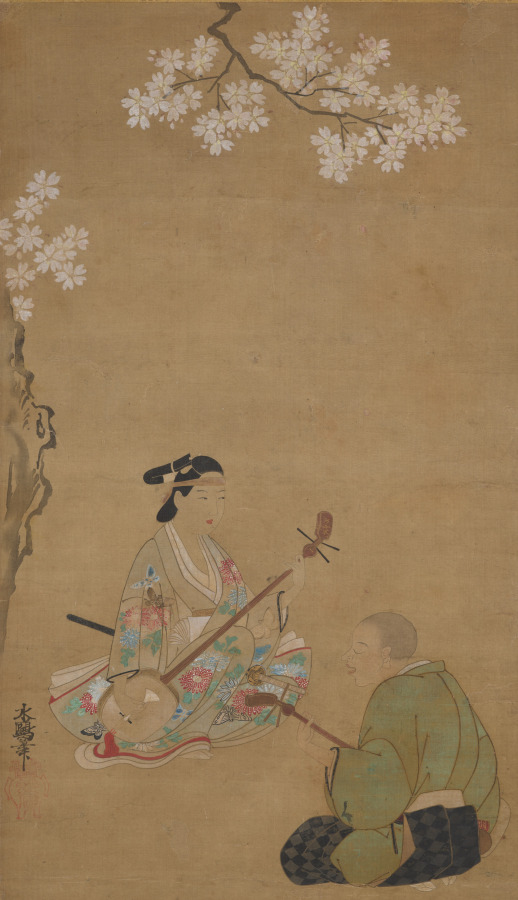
Performing Beneath the Flowers (late 1600s–early 1700s) is in the Cleveland Museum of Art collection. The museum's creator attribution is Tamura Suio (Japanese, active late 1600s–early 1700s).
The work and its context
The museum's open-access catalogue describes the work:
The activity of viewing cherry blossoms is known in Japan as o-hanami, literally “viewing flowers.” Beyond reveling in the spring scene, people also enjoy games and entertainment. In this painting, a beautiful young man strumming a shamisen is brought together with an older blind monk playing what is likely a biwa under the boughs of a cherry in full bloom.
Object facts
- Title: Performing Beneath the Flowers
- Date: late 1600s–early 1700s
- Creator attribution: Tamura Suio (Japanese, active late 1600s–early 1700s)
- Culture: Japan, Edo period (1615–1868)
- Type: Painting
- Technique: Hanging scroll; ink, color, and gold on silk
- Dimensions: Painting: 45.7 x 26.3 cm (18 x 10 3/8 in.); Mounted: 121.2 x 38.2 cm (47 11/16 x 15 1/16 in.)
- Collection: ASIAN - Hanging scroll
- Department: Japanese Art
- Accession number: 2026.44
A detail from the museum
Chrysanthemums are sometimes associated with a character from Chinese lore called the "Chrysanthemum Boy."
Collection credit
The Kelvin Smith Collection, given by Ellen and Bruce Mavec
View the collection record
See the museum's photographs and full catalogue entry. Catalogue text is reproduced from the Cleveland Museum of Art's open-access data, with HTML formatting removed. This object and its supplied image are designated CC0.
Sources
More in Lifestyle
Keep reading