Pharmacy Jar (Albarello) (c. 1450): Art, History and Details
Pharmacy Jar (Albarello) at the Cleveland Museum of Art: c. 1450, tin-glazed earthenware (maiolica). Explore the work's context, creator attribution and collection history.
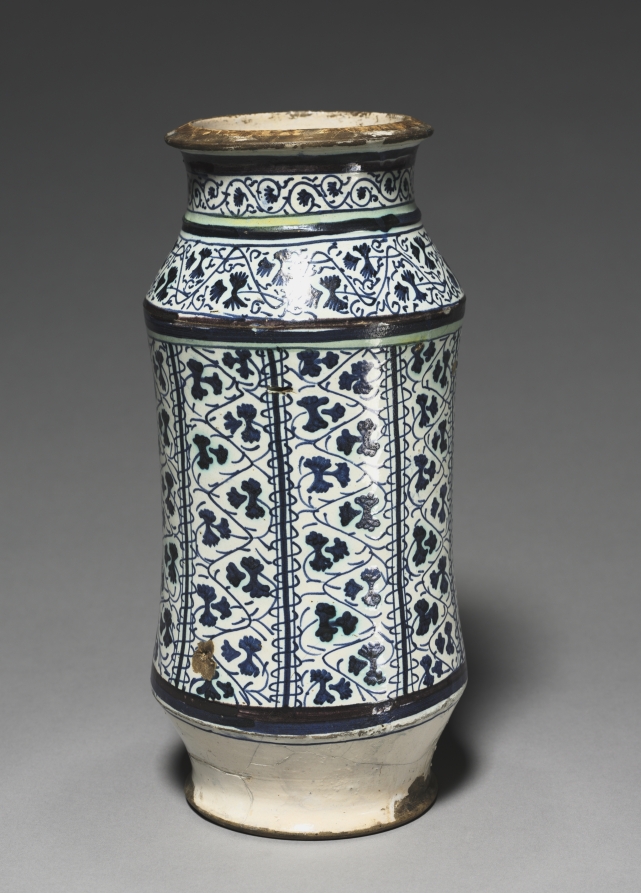
Pharmacy Jar (Albarello) (c. 1450) is in the Cleveland Museum of Art collection.
The work and its context
The museum's open-access catalogue describes the work:
The albarello—a name of uncertain origin—was a pharmacist's jar used to hold dried herbs or medicinal compounds. It was usually closed by means of a piece of parchment or cloth stretched over its mouth and tied with a string. Its characteristic concave sides offered an easy grip to facilitate handling. This large albarello is one of the best of a small number of exquisitely decorated blue-and-white pieces produced in Tuscany in the mid-1400s.
Object facts
- Title: Pharmacy Jar (Albarello)
- Date: c. 1450
- Culture: Italy, Tuscany
- Type: Ceramic
- Technique: tin-glazed earthenware (maiolica)
- Dimensions: Overall: 34.3 x 15.9 cm (13 1/2 x 6 1/4 in.)
- Collection: Decorative Arts
- Department: Decorative Art and Design
- Accession number: 1954.258
Collection credit
Purchase from the J. H. Wade Fund
Further reading listed by the museum
- Cole, Bruce. Italian Maiolica from Midwestern Collections. [Bloomington, Ind.]: Indiana University Art Museum, September 4-October 8, 1977.
View the collection record
See the museum's photographs and full catalogue entry. Catalogue text is reproduced from the Cleveland Museum of Art's open-access data, with HTML formatting removed. This object and its supplied image are designated CC0.
Sources
More in Lifestyle
Keep reading