Textile Fragment with Frontal Deity Heads, Felines, and Interlace Pattern (700–400 BCE): Art, History and Details
Textile Fragment with Frontal Deity Heads, Felines, and Interlace Pattern at the Cleveland Museum of Art: 700–400 BCE, camelid fiber; double-cloth with structural embroidery. Explore the work's context, creator attribution and collection hi
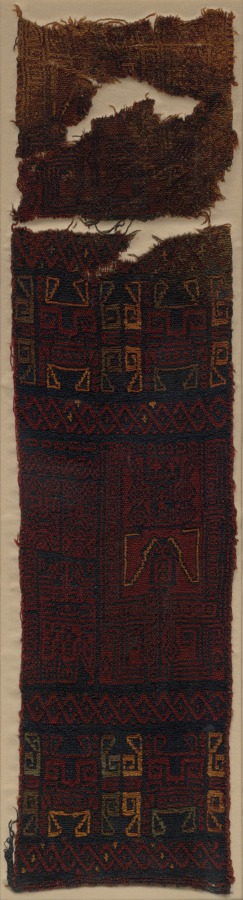
Textile Fragment with Frontal Deity Heads, Felines, and Interlace Pattern (700–400 BCE) is in the Cleveland Museum of Art collection.
The work and its context
The museum's open-access catalogue describes the work:
This textile fragment and (2005.13), belong to a group that represents Andean weavers’ earliest known achievements in double cloth, a technique that allows the creation of identical designs on both faces of the cloth but in reversed colors. They also record the devotion to abstraction typical of the Paracas style. One features three repeats of a highly geometrical standing deity with a fanged mouth. The other includes several stylized deity heads and a blocky, frontally posed feline. The type of garment that these fragments come from remains unknown.
Object facts
- Title: Textile Fragment with Frontal Deity Heads, Felines, and Interlace Pattern
- Date: 700–400 BCE
- Culture: Peru, South Coast, Paracas, Yauca Valley(?)
- Type: Textile
- Technique: camelid fiber; double-cloth with structural embroidery
- Dimensions: Overall: 83.2 x 21.6 cm (32 3/4 x 8 1/2 in.)
- Collection: T - Pre-Columbian
- Department: Textiles
- Accession number: 2005.14
Collection credit
Dudley P. Allen Fund
View the collection record
See the museum's photographs and full catalogue entry. Catalogue text is reproduced from the Cleveland Museum of Art's open-access data, with HTML formatting removed. This object and its supplied image are designated CC0.
Sources
More in Lifestyle
Keep reading