Portrait of a blind man (c. 1750): Art, History and Details
Portrait of a blind man at the Cleveland Museum of Art: c. 1750, Gum tempera on paper. Explore the work's context, creator attribution and collection history.
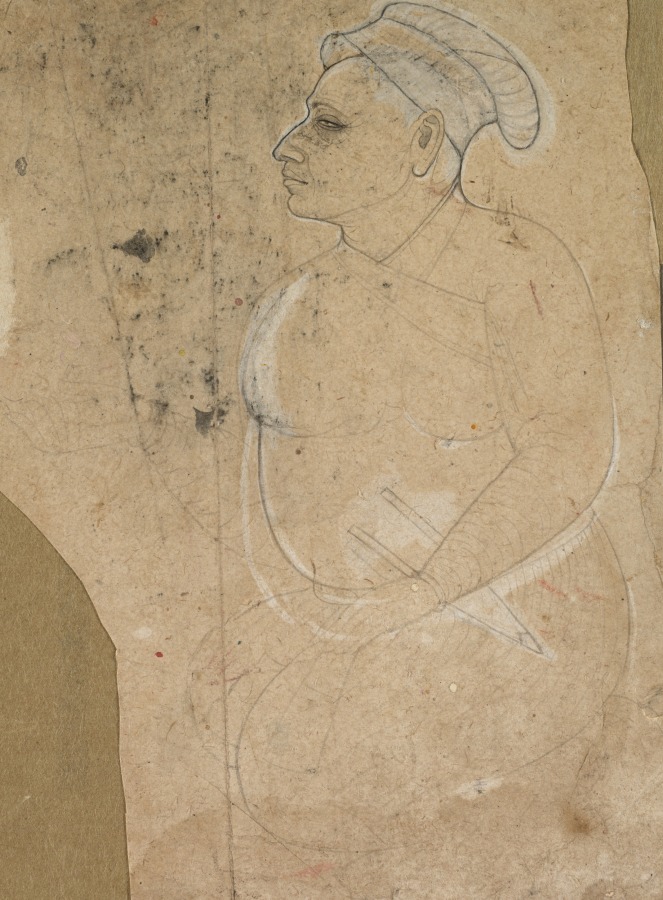
Portrait of a blind man (c. 1750) is in the Cleveland Museum of Art collection.
The work and its context
The museum's open-access catalogue describes the work:
This sensitive portrait survives as a fragment, part of a study for a larger painting. White paint indicates areas the artist reworked. This man’s Mughal tunic, with a katar dagger tucked into the sash, indicates that he is a noble, probably Hindu, because the tunic is tied under the left arm. The gesture of his right hand—just a ghost of an indication—and slightly parted lips suggest that he is making a request.
Object facts
- Title: Portrait of a blind man
- Date: c. 1750
- Culture: Northern India, Pahari kingdoms
- Type: Drawing
- Technique: Gum tempera on paper
- Dimensions: Overall: 18 x 13.3 cm (7 1/16 x 5 1/4 in.)
- Collection: Indian Art
- Department: Indian and Southeast Asian Art
- Accession number: 1968.41
A detail from the museum
The subject of this drawing might be a posthumous portrait of the blind king Sital Dev of Mankot (reigned 1630–1660), who died several decades before this drawing was made.
Collection credit
Cornelia Blakemore Warner Fund
Further reading listed by the museum
- Dwivedi, Vinod P. “A Rasamanjari Painting from Basohli.” The Bulletin of the Cleveland Museum of Art, vol. 56, no. 7, 1969, pp. 262–268.
- Leach, Linda York. Indian Miniature Paintings and Drawings. Cleveland, OH: Cleveland Museum of Art in cooperation with Indiana University Press, 1986.
View the collection record
See the museum's photographs and full catalogue entry. Catalogue text is reproduced from the Cleveland Museum of Art's open-access data, with HTML formatting removed. This object and its supplied image are designated CC0.
Sources
More in Lifestyle
Keep reading