Portrait of a Woman in Blue (c. 1700): Art, History and Details
Portrait of a Woman in Blue at the Cleveland Museum of Art: c. 1700, watercolor on vellum in original ivory frame. Explore the work's context, creator attribution and collection history.
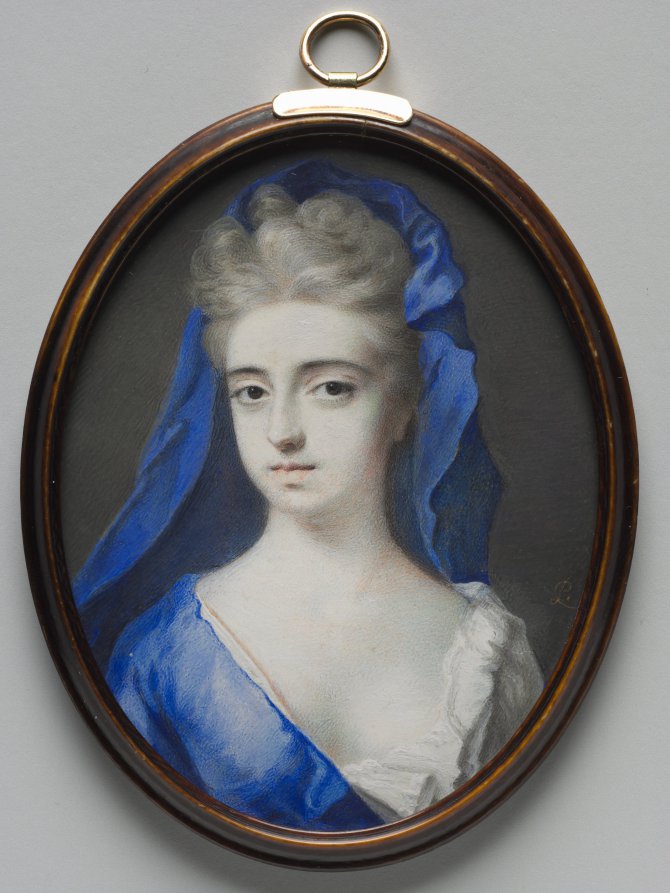
Portrait of a Woman in Blue (c. 1700) is in the Cleveland Museum of Art collection. The museum's creator attribution is Peter Cross (British, c. 1645–1724).
The work and its context
The museum's open-access catalogue describes the work:
Living in London, the youngest of seven children, Peter Cross was probably apprenticed to a limner following the death of his wealthy father. His first miniatures date from around 1661, and he remained active until his death, ushering the medium into the eighteenth century; the greatest British miniaturists working during his lifetime, all had died or ceased to work by 1700. Although ivory had been adopted as a support for British miniature painting a decade before his death, Cross exclusively used the older medium of vellum adhered to card. The artist was also an avid collector, assembling an impressive group of miniatures that included at least twelve works by his neighbor Samuel Cooper. This collection was sold in 1722 at Cross’s house in Covent Garden. Cross’s style is distinguished by a fi ne stippling of colors that combine to create soft, voluminous hair and pale flesh tones. His later works tend to leave the prepared white ground of the vellum bare—coincidentally, a strategy that was adopted by artists painting miniatures on ivory to exploit the support’s translucence. The details of his early instruction are still obscure, but some scholars have postulated that Cooper trained Cross, whereas others note a greater resemblance to the style of Hoskins, and still others detect a similarity to French stippling and suggest that he may have been trained overseas. The artist depicted the unknown sitter almost full face before a plain gray background with her head turned slightly to the right. She dons a white gown trimmed with ruffles at the neckline and a bright blue mantle over her right shoulder. Her powdered hair is swept up and loosely covered either by the blue mantle or a scarf of the same color.
Object facts
- Title: Portrait of a Woman in Blue
- Date: c. 1700
- Creator attribution: Peter Cross (British, c. 1645–1724)
- Culture: England, early 18th Century
- Type: Portrait Miniature
- Technique: watercolor on vellum in original ivory frame
- Dimensions: Framed: 9.2 x 7.3 cm (3 5/8 x 2 7/8 in.); Sight: 8.2 x 6.4 cm (3 1/4 x 2 1/2 in.)
- Collection: P - British before 1800
- Department: European Painting and Sculpture
- Accession number: 1941.554
A detail from the museum
This miniature is in its original ivory frame, stained a mottled brown to imitate tortoise shell.
Collection credit
The Edward B. Greene Collection
Further reading listed by the museum
- Burlington Fine Arts Club, and John Lumsden Propert. Exhibition of Portrait Miniatures. London: Printed for the Burlington fine arts club, 1889.
- Propert, J. Lumsden. “The English School of Miniature Art.” The Magazine of Art 14 (1891).
- Williamson, George Charles, and Howard Coppuck Levis. Portrait Miniatures: From the Time of Holbein 1531 to That of Sir William Ross 1860: a Handbook for Collectors. London: G. Bell, 1897.
View the collection record
See the museum's photographs and full catalogue entry. Catalogue text is reproduced from the Cleveland Museum of Art's open-access data, with HTML formatting removed. This object and its supplied image are designated CC0.
Sources
More in Lifestyle
Keep reading