Posthumous portrait of Emperor Jahangir under a canopy (recto); Calligraphy (verso) (c. 1650): Art, History and Details
Posthumous portrait of Emperor Jahangir under a canopy (recto); Calligraphy (verso) at the Cleveland Museum of Art: c. 1650, Gum tempera, ink, and gold on paper. Explore the work's context, creator attribution and collection history.
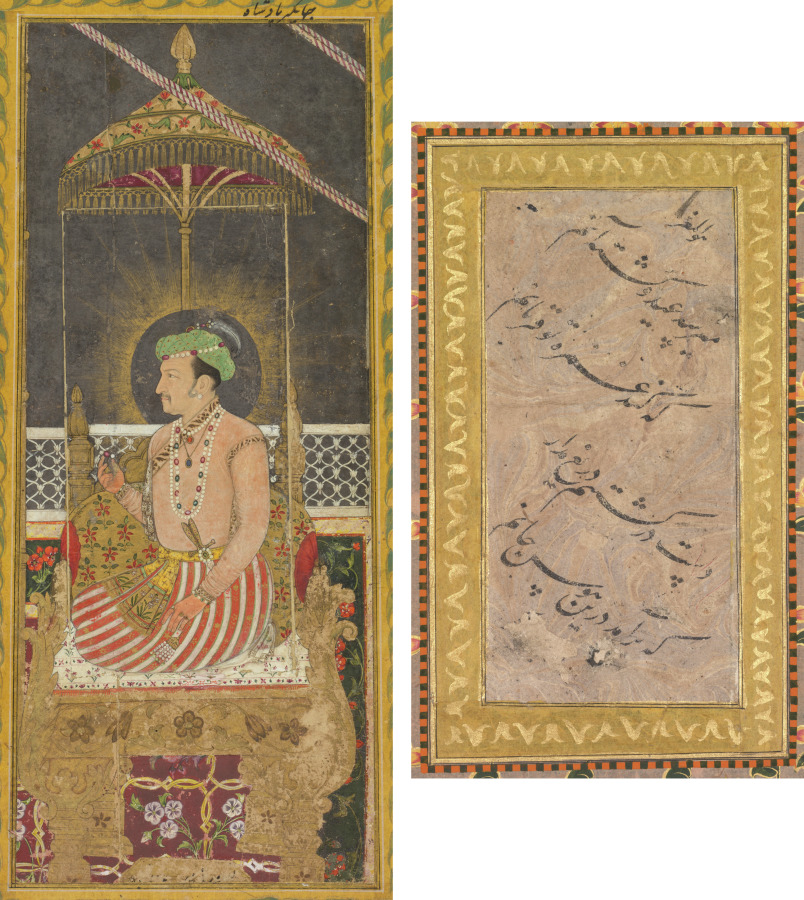
Posthumous portrait of Emperor Jahangir under a canopy (recto); Calligraphy (verso) (c. 1650) is in the Cleveland Museum of Art collection.
The work and its context
The museum's open-access catalogue describes the work:
Jahangir, the fourth Mughal emperor, was remembered for his greatness long after his death. Ruling from 1605 to 1627, he laid the foundations for long-term trade and diplomatic relations with various nations of Europe, most notably England and Portugal. He oversaw the transition of Mughal India into a global power during a time that can be considered the international Age of Exploration. This posthumous portrait depicts Jahangir amid the trappings of wealth and power with the light of divine sanction shining behind his head. A white marble railing demarcates his imperial space.
Object facts
- Title: Posthumous portrait of Emperor Jahangir under a canopy (recto); Calligraphy (verso)
- Date: c. 1650
- Culture: India, Mughal, 17th century
- Type: Painting
- Technique: Gum tempera, ink, and gold on paper
- Dimensions: Page: 35.2 x 22.1 cm (13 7/8 x 8 11/16 in.)
- Collection: Indian Art - Mughal
- Department: Indian and Southeast Asian Art
- Accession number: 2013.329
A detail from the museum
Jahangir holds a ruby or spinel, thought to be a talisman for military victory.
Collection credit
Gift in honor of Madeline Neves Clapp; Gift of Mrs. Henry White Cannon by exchange; Bequest of Louise T. Cooper; Leonard C. Hanna Jr. Fund; From the Catherine and Ralph Benkaim Collection
Further reading listed by the museum
- Mace, Sonya Rhie, Mohsen Ashtiany, Catherine Glynn, Pedro Moura Carvalho, Marcus Fraser, and Ruby Lal. Mughal Paintings: Art and Stories: the Cleveland Museum of Art. London: D Giles Limited, 2016.
- Lal, Ruby. Empress: The Astonishing Reign of Nur Jahan. New York, NY : W.W. Norton & Company, 2018.
View the collection record
See the museum's photographs and full catalogue entry. Catalogue text is reproduced from the Cleveland Museum of Art's open-access data, with HTML formatting removed. This object and its supplied image are designated CC0.
Sources
More in Lifestyle
Keep reading