Prestige Staff (1800s–1900s): Art, History and Details
Prestige Staff at the Cleveland Museum of Art: 1800s–1900s, Wood. Explore the work's context, creator attribution and collection history.
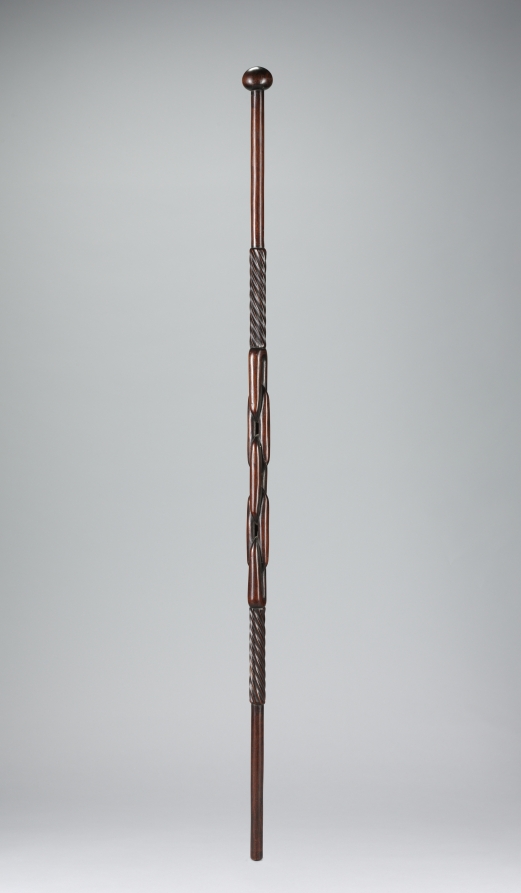
Prestige Staff (1800s–1900s) is in the Cleveland Museum of Art collection.
The work and its context
The museum's open-access catalogue describes the work:
The primary use of long staffs like this was purely practical; they served as walking companions when their pastoralist-owners covered long distances accompanying their cattle in search of new pastures. The tall height of this staff indicates the elevated status or special function of the man who owned it. Carved from one piece of wood, its spherical knob finial and the geometric designs incorporated into its shaft decoration—consisting of spiraling segments and chain links—demonstrate its maker’s superior skills.
Object facts
- Title: Prestige Staff
- Date: 1800s–1900s
- Culture: Africa, Southern Africa, South Africa, Tsonga-style or Zulu-style maker
- Type: Tools and Equipment
- Technique: Wood
- Dimensions: Overall: 116.8 cm (46 in.)
- Collection: African Art
- Department: African Art
- Accession number: 2010.205
A detail from the museum
Tsonga and Zulu staffs all have strong symbolic associations and value. They visually connect the identity of their owners with that of their ancestors and with that of the community to which they belong.
Collection credit
Leonard C. Hanna Jr. Fund
Further reading listed by the museum
- Petridis, Constatine. "The Art of Daily Life: Portable Objects from Southeast Africa. " Tribal Art. (Summer 2011). Pg. 69, Fig. 5.
View the collection record
See the museum's photographs and full catalogue entry. Catalogue text is reproduced from the Cleveland Museum of Art's open-access data, with HTML formatting removed. This object and its supplied image are designated CC0.
Sources
More in Lifestyle
Keep reading
Related stories