Processional Cross (c. 1320): Art, History and Details
Processional Cross at the Cleveland Museum of Art: c. 1320, oil on canvas on wood. Explore the work's context, creator attribution and collection history.
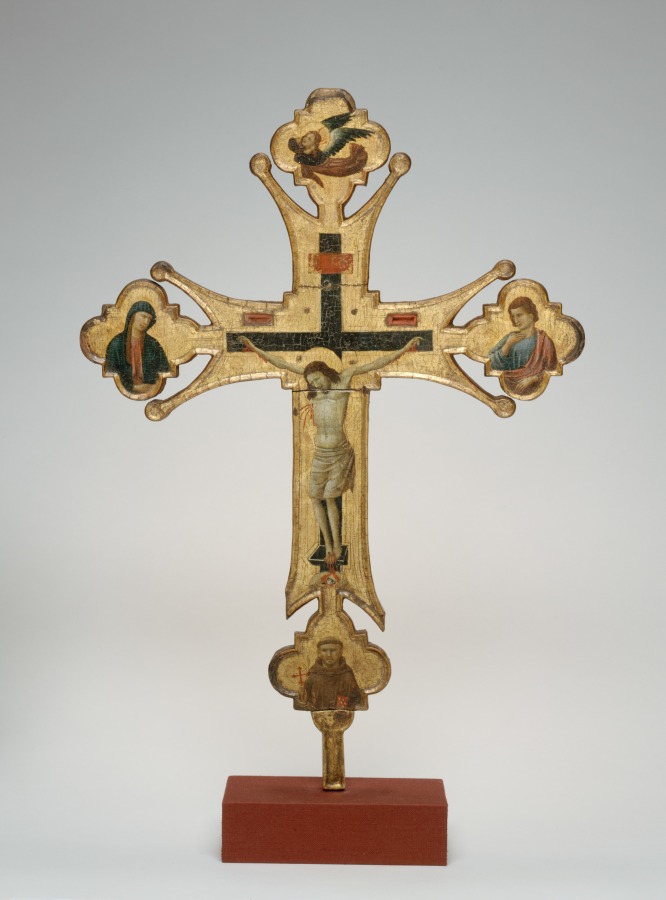
Processional Cross (c. 1320) is in the Cleveland Museum of Art collection. The museum's creator attribution is Master of Santa Chiara (Italian).
The work and its context
The museum's open-access catalogue describes the work:
This cross was originally mounted on a tall pole and carried in religious processions. Therefore, the figures on each side are almost identical. In the center is Christ crucified. Looking on from the elaborate terminals at left and right are the Virgin and Saint John. The bottom terminal shows a different saint on each side: Saint Francis on one and Saint Clare on the other. At the top of each side is an angel. Although one angel looks up and the other down, both express intense grief in their faces and gestures. The Master of Santa Chiara is the name given to this unknown artist who painted this and several other works in Assisi. In that city, Saint Francis founded an order of friars while Saint Clare established a counterpart for women called the Poor Clares. The presence of both saints on this cross suggests that it was made for one of Assisi's Franciscian institutions.
Object facts
- Title: Processional Cross
- Date: c. 1320
- Creator attribution: Master of Santa Chiara (Italian)
- Culture: Italy, Umbria
- Type: Painting
- Technique: oil on canvas on wood
- Dimensions: Unframed: 61.3 x 44.2 x 2.6 cm (24 1/8 x 17 3/8 x 1 in.)
- Collection: MED - Renaissance
- Department: Medieval Art
- Accession number: 1943.280
A detail from the museum
This cross is painted on both sides so that while being carried in a procession the images are visible to a crowd; both sides are not quite identical.
Collection credit
Purchase from the J. H. Wade Fund
Further reading listed by the museum
- American Art Association, Anderson Galleries (Firm), and Achille de Clemente. Italian Furniture of the Renaissance: Rare Majolica, Brocades, Velvets, Renaissance Bronzes, Sculptures, Stone and Terra Cotta Groups, Primitive and Renaissance Paintings. [New York]: American Art Association, Anderson Galleries, 1931.
- Francis, Henry S. "A Fifteenth-Century Florentine Processional Cross." The Bulletin of the Cleveland Museum of Art 32, no. 1 (1945).
- Offner, Richard, Klara Steinweg, and Hayden B. J. Maginnis. A Critical and Historical Corpus of Florentine Painting. [New York]: College of Fine Arts, New York University, 1930.
View the collection record
See the museum's photographs and full catalogue entry. Catalogue text is reproduced from the Cleveland Museum of Art's open-access data, with HTML formatting removed. This object and its supplied image are designated CC0.
Sources
More in Lifestyle
Keep reading