Prunus Vase with Amaranth (1914–46): Art, History and Details
Prunus Vase with Amaranth at the Cleveland Museum of Art: 1914–46, Porcelain with yellow glaze and overglaze color enamel and gold. Explore the work's context, creator attribution and collection history.
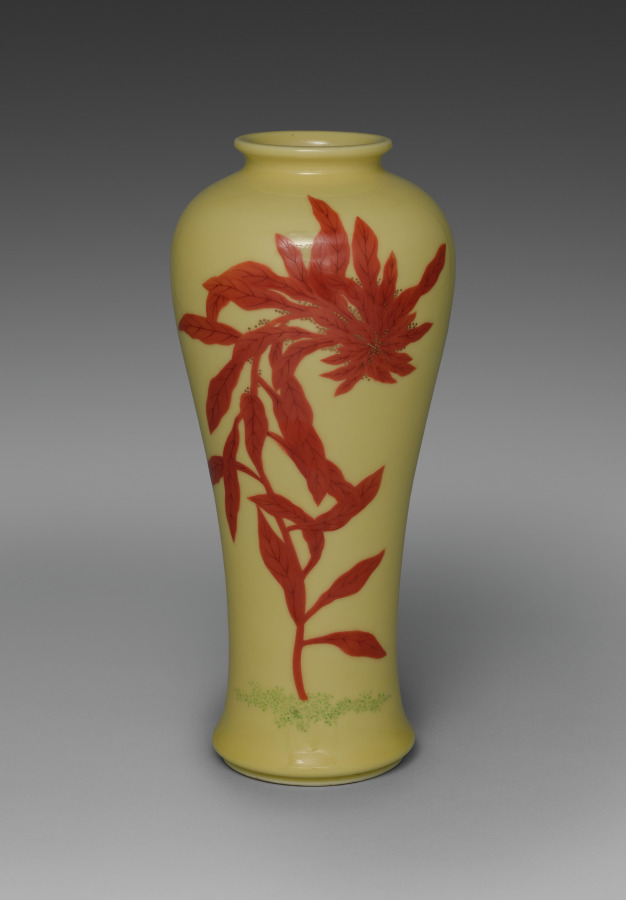
Prunus Vase with Amaranth (1914–46) is in the Cleveland Museum of Art collection. The museum's creator attribution is Seifū Yohei IV (Japanese, 1872–1951).
The work and its context
The museum's open-access catalogue describes the work:
Yohei IV’s interest in bold, colorful designs is on full display in this vase shaped like a “prunus vase,” or meiping (Japanese meipin). It has two colors of amaranthus on a yellow ground. It follows a design appearing on a sleeve-shaped vase by Yohei III. Yohei IV uses bright spring-green dots of overglaze enamel to suggest a ground plane in his yellow environment; he also uses red and magenta accented with wild gold cascades of dots for two plants he places on opposite sides of the vase, one much larger than the other. In Yohei III’s version, the body of the vessel is white, and the foliage of one plant is red with carefully painted veins in gold, while another plant strategically positioned behind it has a deep rust color, again carefully detailed in gold. In a sense, Yohei IV has deconstructed his father’s logical, balanced design and re-presented it as an emotive, lightheartedly chaotic one that sates the appetite for instant gratification, much as his father’s creation rewards the pursuit of elegance.
Object facts
- Title: Prunus Vase with Amaranth
- Date: 1914–46
- Creator attribution: Seifū Yohei IV (Japanese, 1872–1951)
- Culture: Japan, Taishō period (1912–26)
- Type: Ceramic
- Technique: Porcelain with yellow glaze and overglaze color enamel and gold
- Dimensions: height: 29.8 cm (11 3/4 in.); Diameter: 11.4 cm (4 1/2 in.); height with stand: 32.4 cm (12 3/4 in.)
- Collection: Japanese Art
- Department: Japanese Art
- Accession number: 2022.229
A detail from the museum
Seifū Yohei IV continued to create works in the studio’s signature colors but also produced pieces with strong color and flare that were his interpretations of Qing dynasty (1644–1911) glazes.
Collection credit
Gift of James and Christine Heusinger
Further reading listed by the museum
- Maezaki, Shinya and Sinéad Vilbar. Colors of Kyoto: The Seifū Yohei Ceramic Studio. Cleveland, OH: The Cleveland Museum of Art, 2023.
- Goodall, Hollis. "Seifū Yohei III: Master of Finesse." Impressions: The Journal of the Japanese Art Society of America 45, part 2 (2024): 178-193.
View the collection record
See the museum's photographs and full catalogue entry. Catalogue text is reproduced from the Cleveland Museum of Art's open-access data, with HTML formatting removed. This object and its supplied image are designated CC0.
Sources
More in Lifestyle
Keep reading