Qur'an Manuscript Folio (recto) (1200s–1300s): Art, History and Details
Qur'an Manuscript Folio (recto) at the Cleveland Museum of Art: 1200s–1300s, ink, gold, and color on parchment. Explore the work's context, creator attribution and collection history.
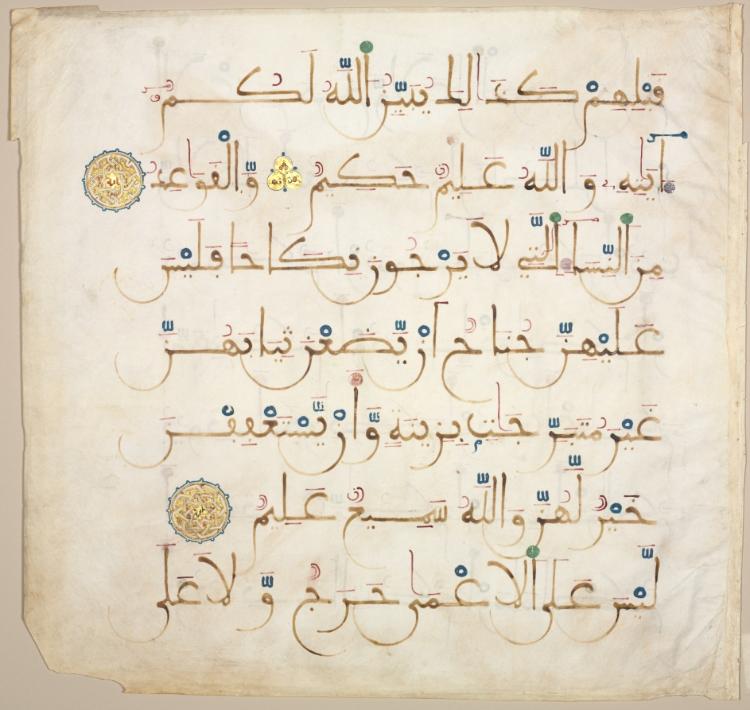
Qur'an Manuscript Folio (recto) (1200s–1300s) is in the Cleveland Museum of Art collection.
The work and its context
The museum's open-access catalogue describes the work:
This page from the “Chapter of Light” (24:59–61) in the Qur'an is written in the monumental script of Islamic Spain and North Africa, known as Maghribi Kufic. Words flow rhythmically with curving flourishes toward the left margin where letters end in almost perfect semicircles, an elegant hallmark that contrasts with the upright shafts. Distinctive markings—vowels in red and diacritics in blue—identify the vocalization of the text, which would have been read or recited aloud to an assembly.
Object facts
- Title: Qur'an Manuscript Folio (recto)
- Date: 1200s–1300s
- Culture: Southern Spain
- Type: Manuscript
- Technique: ink, gold, and color on parchment
- Dimensions: Sheet: 52.7 x 55.4 cm (20 3/4 x 21 13/16 in.); Text area: 46.5 x 44 cm (18 5/16 x 17 5/16 in.)
- Collection: Islamic Art
- Department: Islamic Art
- Accession number: 1933.440.a
Collection credit
Edward L. Whittemore Fund
Further reading listed by the museum
- Franklin, David and C. Griffith Mann. Treasures from the Cleveland Museum of Art. Cleveland, OH: Cleveland Museum of Art, 2012.
View the collection record
See the museum's photographs and full catalogue entry. Catalogue text is reproduced from the Cleveland Museum of Art's open-access data, with HTML formatting removed. This object and its supplied image are designated CC0.
Sources
More in Lifestyle
Keep reading