Red-Figure Lekythos (Oil Vessel): Athena Slaying Giant (body); Satyr between Maenads (shoulder) (c. 490 BCE): Art, History and Details
Red-Figure Lekythos (Oil Vessel): Athena Slaying Giant (body); Satyr between Maenads (shoulder) at the Cleveland Museum of Art: c. 490 BCE, ceramic. Explore the work's context, creator attribution and collection history.
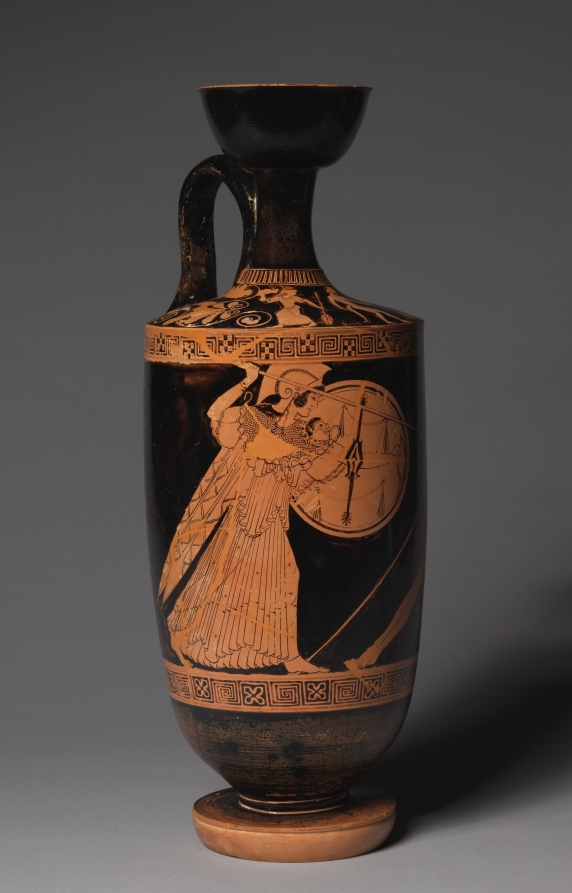
Red-Figure Lekythos (Oil Vessel): Athena Slaying Giant (body); Satyr between Maenads (shoulder) (c. 490 BCE) is in the Cleveland Museum of Art collection. The museum's creator attribution is Berlin Painter (Greek, Attic, active c. 505–460 BC); Painter of Goluchow 37 (Greek, Attic, active c. 490–460 BC).
The work and its context
The museum's open-access catalogue describes the work:
The two separate areas of figural decoration on this vase have been attributed to different painters: the small satyr and maenads on the shoulder to the Berlin Painter; and the larger figures of Athena and the slain Giant Enkelados on the body to the Painter of Goluchow 37. Scholars have named these two painters, whose actual names remain unknown, after other vases they have painted, now in Berlin and Warsaw. The victory of Athena and the Olympian gods over the Giants has been interpreted as a metaphor for the Greek victory over the Persians around the time this vase was made. Thus, although Enkelados appears as a fully armed warrior, he falls in utter and complete defeat—bleeding from multiple wounds, eyes rolling back, sword dropping from his hand.
Object facts
- Title: Red-Figure Lekythos (Oil Vessel): Athena Slaying Giant (body); Satyr between Maenads (shoulder)
- Date: c. 490 BCE
- Creator attribution: Berlin Painter (Greek, Attic, active c. 505–460 BC); Painter of Goluchow 37 (Greek, Attic, active c. 490–460 BC)
- Culture: Greek, Attic
- Type: Ceramic
- Technique: ceramic
- Dimensions: Diameter: 14.1 cm (5 9/16 in.); Diameter of mouth: 8.7 cm (3 7/16 in.); Overall: 38 cm (14 15/16 in.); Diameter of foot: 10 cm (3 15/16 in.)
- Collection: GR - Greek
- Department: Greek and Roman Art
- Accession number: 1978.59
A detail from the museum
First attributed to Douris, this vase is now thought to have been painted by two anonymous painters.
Collection credit
Purchase from the J. H. Wade Fund
Further reading listed by the museum
- Beazley Archive. n.d. Beazley Archive Pottery Database. Oxford: Beazley Archive.
- Boulter, C. G., Jenifer Neils, and Gisela Walberg. Corpus Vasorum Antiquorum. Princeton, N.J.: Princeton University Press, 1971.
- Moon, Warren G., and Louise Berge. Greek Vase-Painting in Midwestern Collections. Chicago: Art Institute, 1979.
View the collection record
See the museum's photographs and full catalogue entry. Catalogue text is reproduced from the Cleveland Museum of Art's open-access data, with HTML formatting removed. This object and its supplied image are designated CC0.
Sources
More in Lifestyle
Keep reading