Roundel from a Tunic with Palmette Tree (700s–800s): Art, History and Details
Roundel from a Tunic with Palmette Tree at the Cleveland Museum of Art: 700s–800s, Silk; complementary weft-faced twill weave with inner warps (samite). Explore the work's context, creator attribution and collection history.
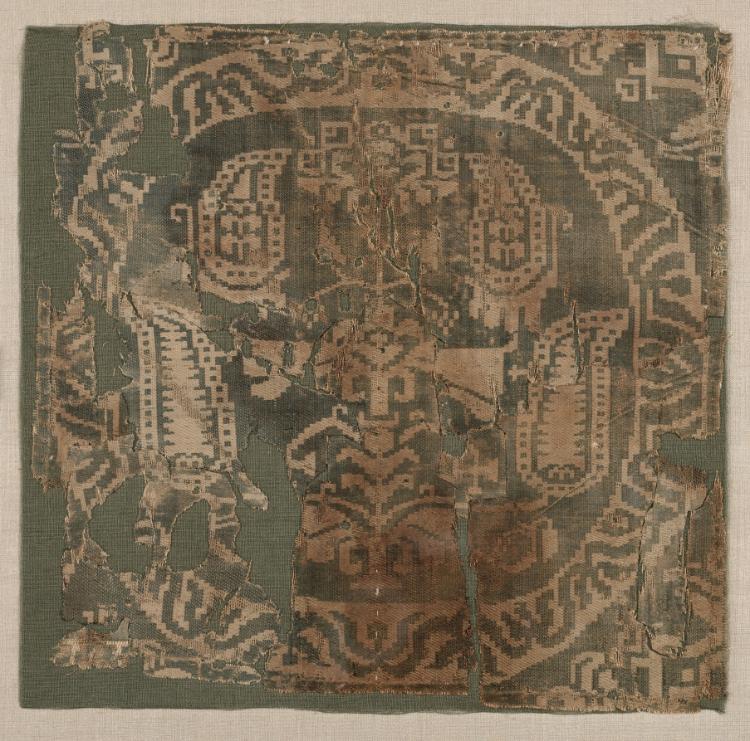
Roundel from a Tunic with Palmette Tree (700s–800s) is in the Cleveland Museum of Art collection.
The work and its context
The museum's open-access catalogue describes the work:
Four or six squares of this luxurious two-color silk were originally sewn on a linen tunic, two positioned above the hemline in the front and two in the back, and possibly two more at the shoulder. The folded edges are still visible, including a silk sewing thread on the right side. The brittle condition is evident in the numerous crisp breaks.
Object facts
- Title: Roundel from a Tunic with Palmette Tree
- Date: 700s–800s
- Culture: Egypt or Syria
- Type: Textile
- Technique: Silk; complementary weft-faced twill weave with inner warps (samite)
- Dimensions: Overall: 18.1 x 18.4 cm (7 1/8 x 7 1/4 in.); Mounted: 27.9 x 26.7 cm (11 x 10 1/2 in.)
- Collection: Textiles
- Department: Textiles
- Accession number: 1982.296
A detail from the museum
Originally designed in Byzantine Egypt or possibly Syria, patterns like this were woven throughout a period of two to four centuries.
Collection credit
Purchase from the J. H. Wade Fund
View the collection record
See the museum's photographs and full catalogue entry. Catalogue text is reproduced from the Cleveland Museum of Art's open-access data, with HTML formatting removed. This object and its supplied image are designated CC0.
Sources
More in Lifestyle
Keep reading