Roundel with curvilinear palmette tree, from a tunic (600–850): Art, History and Details
Roundel with curvilinear palmette tree, from a tunic at the Cleveland Museum of Art: 600–850, Silk; complementary weft-faced twill weave with inner warps (samite). Explore the work's context, creator attribution and collection history.
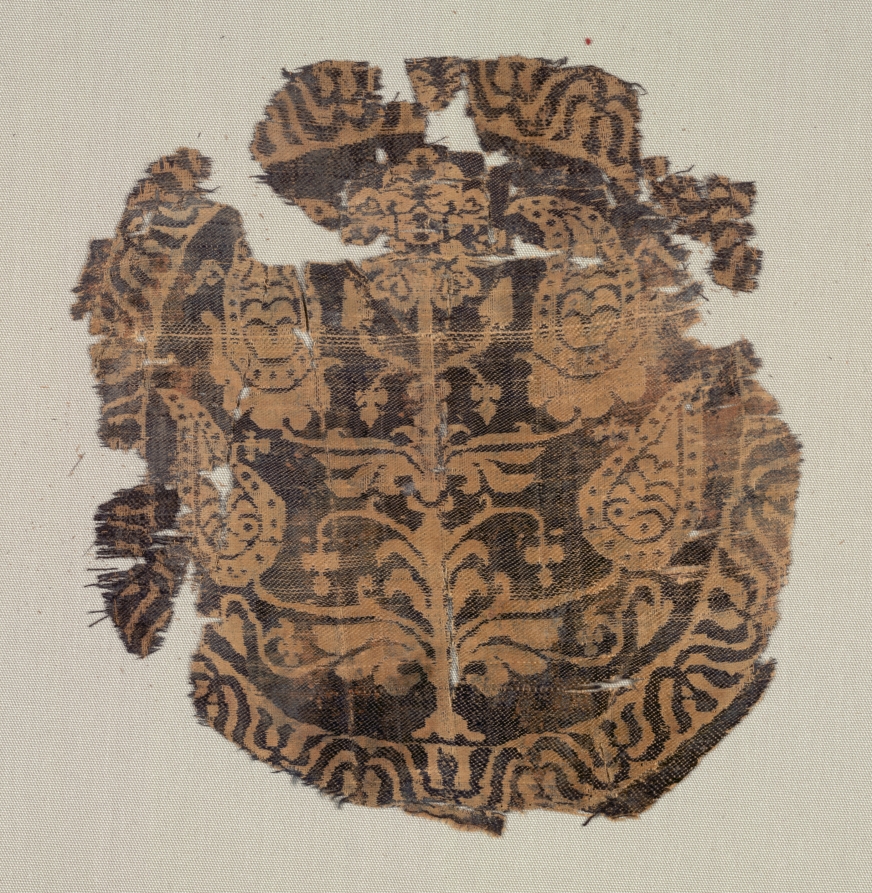
Roundel with curvilinear palmette tree, from a tunic (600–850) is in the Cleveland Museum of Art collection.
The work and its context
The museum's open-access catalogue describes the work:
Originally, roundels like this were cut and sewn onto the front and back of a tunic, probably linen, in Egypt. They belong to a sizeable group of comparable silk decorations found in Akhmim, Egypt. In each roundel, a stylized palmette tree is enclosed within a simplified lotus border that evolved from an ancient Egyptian lotus motif.
Object facts
- Title: Roundel with curvilinear palmette tree, from a tunic
- Date: 600–850
- Culture: Egypt or Syria(?)
- Type: Textile
- Technique: Silk; complementary weft-faced twill weave with inner warps (samite)
- Dimensions: Overall: 20.6 x 19 cm (8 1/8 x 7 1/2 in.); Mounted: 27.9 x 26.7 cm (11 x 10 1/2 in.)
- Collection: Textiles
- Department: Textiles
- Accession number: 1952.102
A detail from the museum
This elaborate pattern was woven on a large, early loom known as a drawloom that automatically repeated designs across the width of the fabric.
Collection credit
Purchase from the J. H. Wade Fund
Further reading listed by the museum
- Mackie, Louise W. Symbols of Power: Luxury Textiles from Islamic Lands, 7th-21st Century. Cleveland; New Haven: Cleveland Museum of Art; Yale University Press, 2015.
View the collection record
See the museum's photographs and full catalogue entry. Catalogue text is reproduced from the Cleveland Museum of Art's open-access data, with HTML formatting removed. This object and its supplied image are designated CC0.
Sources
More in Lifestyle
Keep reading