Saddled Arabian Horse in Courtyard (1820): Art, History and Details
Saddled Arabian Horse in Courtyard at the Cleveland Museum of Art: 1820, pen and brown ink, brown wash, with gray wash, over black chalk or crayon, heightened with white gouache and white chalk. Explore the work's context, creator attributi
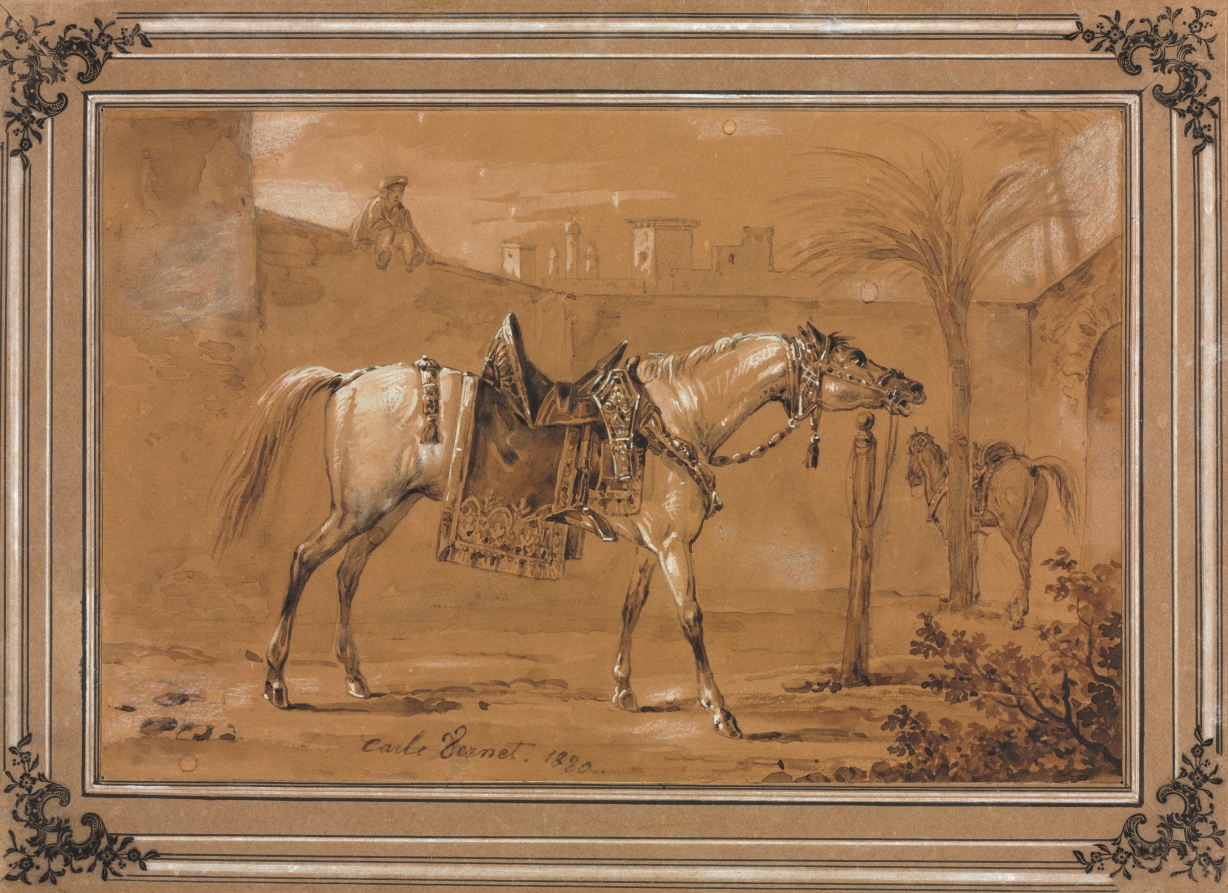
Saddled Arabian Horse in Courtyard (1820) is in the Cleveland Museum of Art collection. The museum's creator attribution is Carle Vernet (French, 1758–1836).
The work and its context
The museum's open-access catalogue describes the work:
While his father, Joseph, was known for marine paintings, and his son, Horace, became a celebrated Romantic artist, Carle Vernet excelled in representing battles and animals, especially horses. Vernet was an expert rider himself, and in his pictures he precisely described various breeds and horse dressings. Although the artist never traveled further from France than Italy, his drawing of an Arabian horse contains elements that make it seem as if he observed the animal in its native environment. He documented the unique saddle and included exotic architecture in the background and palm trees at the right. Vernet was able to study exotic breeds and costumes in Paris, both in the military corps and at the horse races.
Object facts
- Title: Saddled Arabian Horse in Courtyard
- Date: 1820
- Creator attribution: Carle Vernet (French, 1758–1836)
- Culture: France, 19th century
- Type: Drawing
- Technique: pen and brown ink, brown wash, with gray wash, over black chalk or crayon, heightened with white gouache and white chalk
- Dimensions: Sheet: 15.8 x 24.2 cm (6 1/4 x 9 1/2 in.); With mount: 22.3 x 30.7 cm (8 3/4 x 12 1/16 in.)
- Collection: DR - French
- Department: Drawings
- Accession number: 2008.398
Collection credit
Bequest of Muriel Butkin
Further reading listed by the museum
- Foster, Carter E., Sylvain Bellenger, and Patrick Shaw Cable. French Master Drawings from the Collection of Muriel Butkin. [Cleveland, Ohio]: Cleveland Museum of Art, 2001.
View the collection record
See the museum's photographs and full catalogue entry. Catalogue text is reproduced from the Cleveland Museum of Art's open-access data, with HTML formatting removed. This object and its supplied image are designated CC0.
Sources
More in Lifestyle
Keep reading
Related stories