Saint John the Evangelist (c. 1400): Art, History and Details
Saint John the Evangelist at the Cleveland Museum of Art: c. 1400, polychromed walnut. Explore the work's context, creator attribution and collection history.
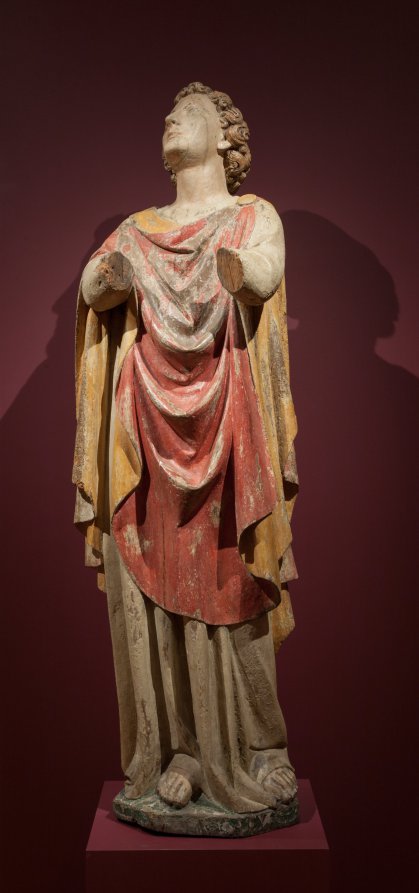
Saint John the Evangelist (c. 1400) is in the Cleveland Museum of Art collection.
The work and its context
The museum's open-access catalogue describes the work:
This sculpture was originally part of a life-sized Crucifixion group and intended to be seen with two more statues: a crucified Christ and a standing Virgin. Multifigured ensembles in wood belong to a vigorous tradition in central Italy extending from the 1200s to the 1400s. Most commonly, these groups represent the Deposition (Christ being lowered from the cross) or the Lamentation (Mary cradling the dead Christ on her lap). Crucifixion groups consisted of a central sculpture of Christ on the cross flanked on his right by the Virgin Mary and on his left by Saint John the Evangelist. Such groups were often displayed during Holy Week in Italy and Spain.
Object facts
- Title: Saint John the Evangelist
- Date: c. 1400
- Culture: Italy, Tuscany
- Type: Sculpture
- Technique: polychromed walnut
- Dimensions: Overall: 156.2 cm (61 1/2 in.)
- Collection: MED - Gothic
- Department: Medieval Art
- Accession number: 1960.75
Collection credit
John L. Severance Fund
Further reading listed by the museum
- Moskowitz, Anita F. “A Neglected Tuscan Figure in the Medieval Collection.” The Bulletin of the Cleveland Museum of Art 81, no. 9 (November 1994): 366–375.
View the collection record
See the museum's photographs and full catalogue entry. Catalogue text is reproduced from the Cleveland Museum of Art's open-access data, with HTML formatting removed. This object and its supplied image are designated CC0.
Sources
More in Lifestyle
Keep reading