Samantabhadra (1100s): Art, History and Details
Samantabhadra at the Cleveland Museum of Art: 1100s, hanging scroll; ink and color on silk. Explore the work's context, creator attribution and collection history.
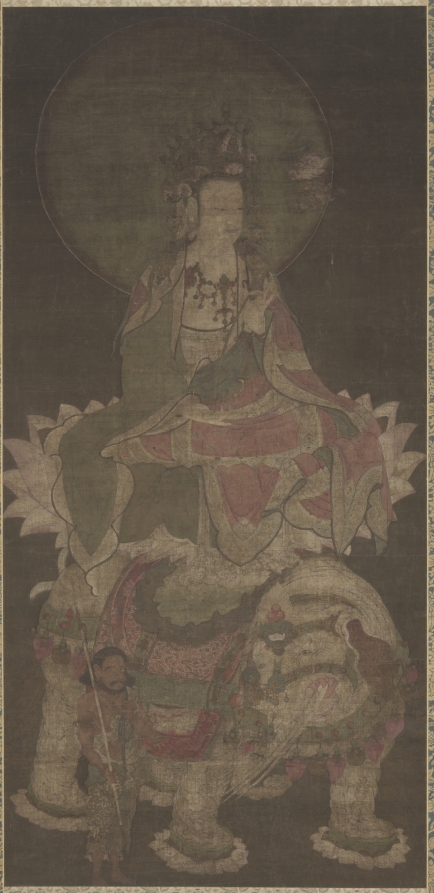
Samantabhadra (1100s) is in the Cleveland Museum of Art collection.
The work and its context
The museum's open-access catalogue describes the work:
In the last chapter of the Lotus Sutra, one of the principal Buddhist texts, the great Bodhisattva Samantabhadra is described advancing to earth, riding on a six-tusked elephant, and proclaiming himself protector of the faithful. More frequently, he is shown with Bodhisattva Manjusri as the attendants of Shakyamuni (the historical Buddha). This scroll is probably the left panel in a triptych (group of three paintings) portraying these deities.
Object facts
- Title: Samantabhadra
- Date: 1100s
- Culture: China, Southern Song dynasty (1127-1279)
- Type: Painting
- Technique: hanging scroll; ink and color on silk
- Dimensions: Image: 114.8 x 55.1 cm (45 3/16 x 21 11/16 in.); Mounted: 208.6 x 75.4 cm (82 1/8 x 29 11/16 in.)
- Collection: ASIAN - Hanging scroll
- Department: Chinese Art
- Accession number: 1962.161
A detail from the museum
Samantabhadra holds a lotus with a sutra on top of the blossom.
Collection credit
Mr. and Mrs. William H. Marlatt Fund
Further reading listed by the museum
- Cahill, James. The Art of Southern Sung China. New York: Asia House, 1962.
- Sullivan, Michael. Chinese and Japanese Art. New York: Grolier, 1965.
- The Cleveland Museum of Art. Handbook of the Cleveland Museum of Art/1966. Cleveland, OH: The Cleveland Museum of Art, 1966.
View the collection record
See the museum's photographs and full catalogue entry. Catalogue text is reproduced from the Cleveland Museum of Art's open-access data, with HTML formatting removed. This object and its supplied image are designated CC0.
Sources
More in Lifestyle
Keep reading
Related stories