Seated Buddha (200s CE): Art, History and Details
Seated Buddha at the Cleveland Museum of Art: 200s CE, sandstone. Explore the work's context, creator attribution and collection history.
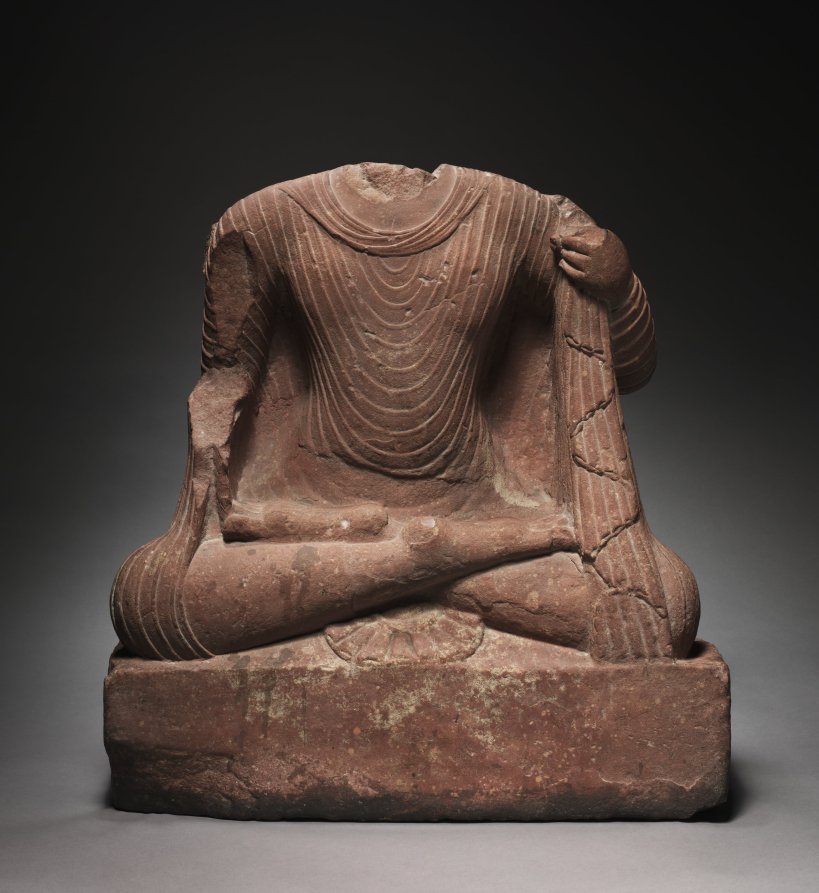
Seated Buddha (200s CE) is in the Cleveland Museum of Art collection.
The work and its context
The museum's open-access catalogue describes the work:
Artists in the north Indian city of Mathura reinterpreted the appearance of the Greco-Roman style of drapery, which was popular in the region of Gandhara, in present-day Pakistan. They preferred a more otherworldly, abstracted rendition of the folds, giving the Buddha a powerful, superhuman energy.
Object facts
- Title: Seated Buddha
- Date: 200s CE
- Culture: Northern India, Mathura, Kushan period
- Type: Sculpture
- Technique: sandstone
- Dimensions: Overall: 63 x 58.5 cm (24 13/16 x 23 1/16 in.)
- Collection: Indian Art - Kushan, Mathura
- Department: Indian and Southeast Asian Art
- Accession number: 1941.94
Collection credit
Edward L. Whittemore Fund
Further reading listed by the museum
- Coomaraswamy, Ananda K. “The Origin of the Buddha Image.” The Art Bulletin, vol. 9, no. 4, 1927, pp. 287–329.
- Hollis, Howard. “Buddhist Statue from Mathurā.” The Bulletin of the Cleveland Museum of Art, vol. 29, no. 6, 1942, pp. 98, 100–102.
- Lee, Sherman E. Buddhist Art. Detroit Institute of Arts, Twenty-Fourth Loan Exhibition, October, 1942. Detroit: Detroit Institute of Arts, 1942.
View the collection record
See the museum's photographs and full catalogue entry. Catalogue text is reproduced from the Cleveland Museum of Art's open-access data, with HTML formatting removed. This object and its supplied image are designated CC0.
Sources
More in Lifestyle
Keep reading