Sleeping Cat (early to mid-1800s): Art, History and Details
Sleeping Cat at the Cleveland Museum of Art: early to mid-1800s, Porcelain with overglaze color enamel and gold (Hizen ware). Explore the work's context, creator attribution and collection history.
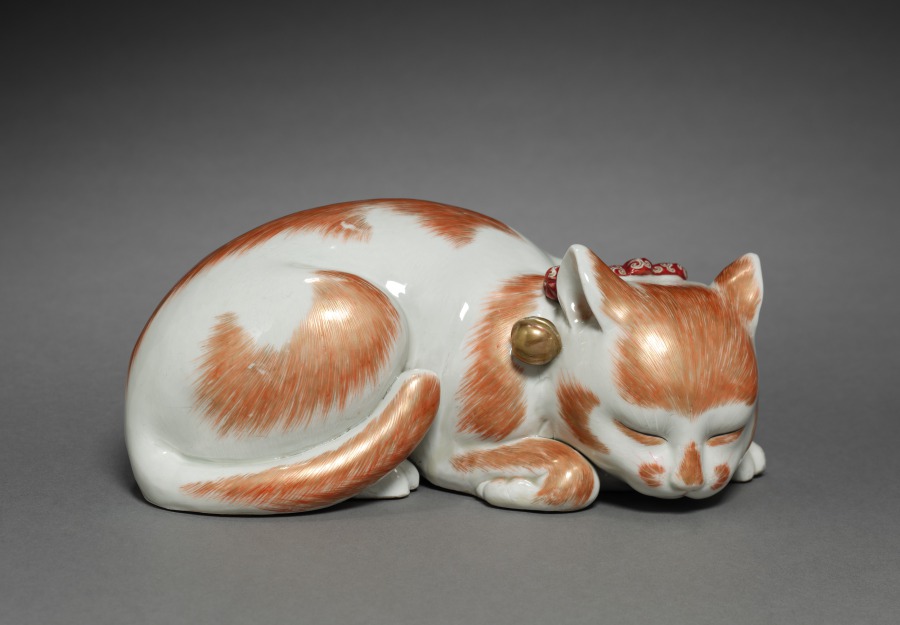
Sleeping Cat (early to mid-1800s) is in the Cleveland Museum of Art collection.
The work and its context
The museum's open-access catalogue describes the work:
Models of sleeping cats with collars and bells like this one were popular as decorative objects, and some of them also served as incense burners or hand warmers. This cat was just for display and has very carefully incised lines in the surface of the clay body, as well as thin strokes of orange and gold over the glaze to create the sense of soft fur.
Object facts
- Title: Sleeping Cat
- Date: early to mid-1800s
- Culture: Japan, Edo period (1615–1868)
- Type: Sculpture
- Technique: Porcelain with overglaze color enamel and gold (Hizen ware)
- Dimensions: Overall: 9.5 x 14.6 cm (3 3/4 x 5 3/4 in.)
- Collection: Japanese Art
- Department: Japanese Art
- Accession number: 1964.255
Collection credit
Severance and Greta Millikin Collection
Further reading listed by the museum
- Monet, Claude, and David Bromfield. Monet & Japan. Canberra: National Gallery of Australia, 2001.
View the collection record
See the museum's photographs and full catalogue entry. Catalogue text is reproduced from the Cleveland Museum of Art's open-access data, with HTML formatting removed. This object and its supplied image are designated CC0.
Sources
More in Lifestyle
Keep reading