Square Ornament from a Tunic (700s): Art, History and Details
Square Ornament from a Tunic at the Cleveland Museum of Art: 700s, Silk; complementary weft-faced twill weave with inner warps (samite). Explore the work's context, creator attribution and collection history.
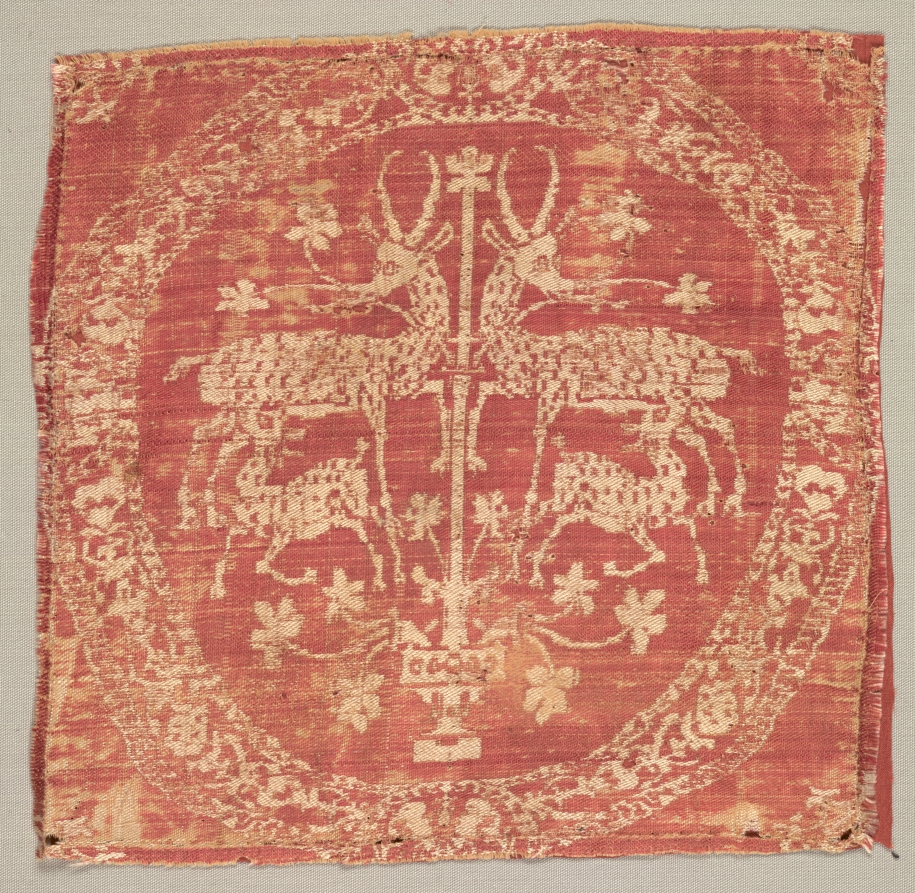
Square Ornament from a Tunic (700s) is in the Cleveland Museum of Art collection.
The work and its context
The museum's open-access catalogue describes the work:
The folded edges on all four sides of this luxury silk fragment indicate that it decorated a unisex linen tunic. The symmetrical deer with suckling fawn flanking a simplified central tree of life continues an ancient theme in a naturalistic style. The roundel is connected on all four sides and displays heart-shaped floral borders. This fragment is said to have been found in Akhmim, Egypt, south of Cairo, where, during the 1880s, numerous related silk fragments were excavated.
Object facts
- Title: Square Ornament from a Tunic
- Date: 700s
- Culture: Egypt or Syria, Umayyad period (661–750) or Abbasid period (750–1258)
- Type: Textile
- Technique: Silk; complementary weft-faced twill weave with inner warps (samite)
- Dimensions: Overall: 23.5 x 24.2 cm (9 1/4 x 9 1/2 in.); Mounted: 31.1 x 31.8 cm (12 1/4 x 12 1/2 in.)
- Collection: T - Islamic
- Department: Textiles
- Accession number: 1947.192
A detail from the museum
Seen as a prized decoration, designs like this were often cut out of older textiles and stitched onto unisex linen tunics.
Collection credit
Purchase from the J. H. Wade Fund
Further reading listed by the museum
- Shepherd, Dorothy. "A Silk Fabric from Egypt." The Bulletin of the Cleveland Museum of Art 34, no. 8 (1947): 196-99.
- The Cleveland Museum of Art. The Cleveland Museum of Art Handbook. Cleveland, OH: The Cleveland Museum of Art, 1958.
- Beckwith, John. Caskets from Cordoba. [Victoria and Albert Museum Publications, 1958-1960]. London: H.M. Stationery Office, 1960.
View the collection record
See the museum's photographs and full catalogue entry. Catalogue text is reproduced from the Cleveland Museum of Art's open-access data, with HTML formatting removed. This object and its supplied image are designated CC0.
Sources
More in Lifestyle
Keep reading