Squat Jar with Lug Handles (2950–2573 BCE): Art, History and Details
Squat Jar with Lug Handles at the Cleveland Museum of Art: 2950–2573 BCE, pegmatitic hornblende diorite. Explore the work's context, creator attribution and collection history.
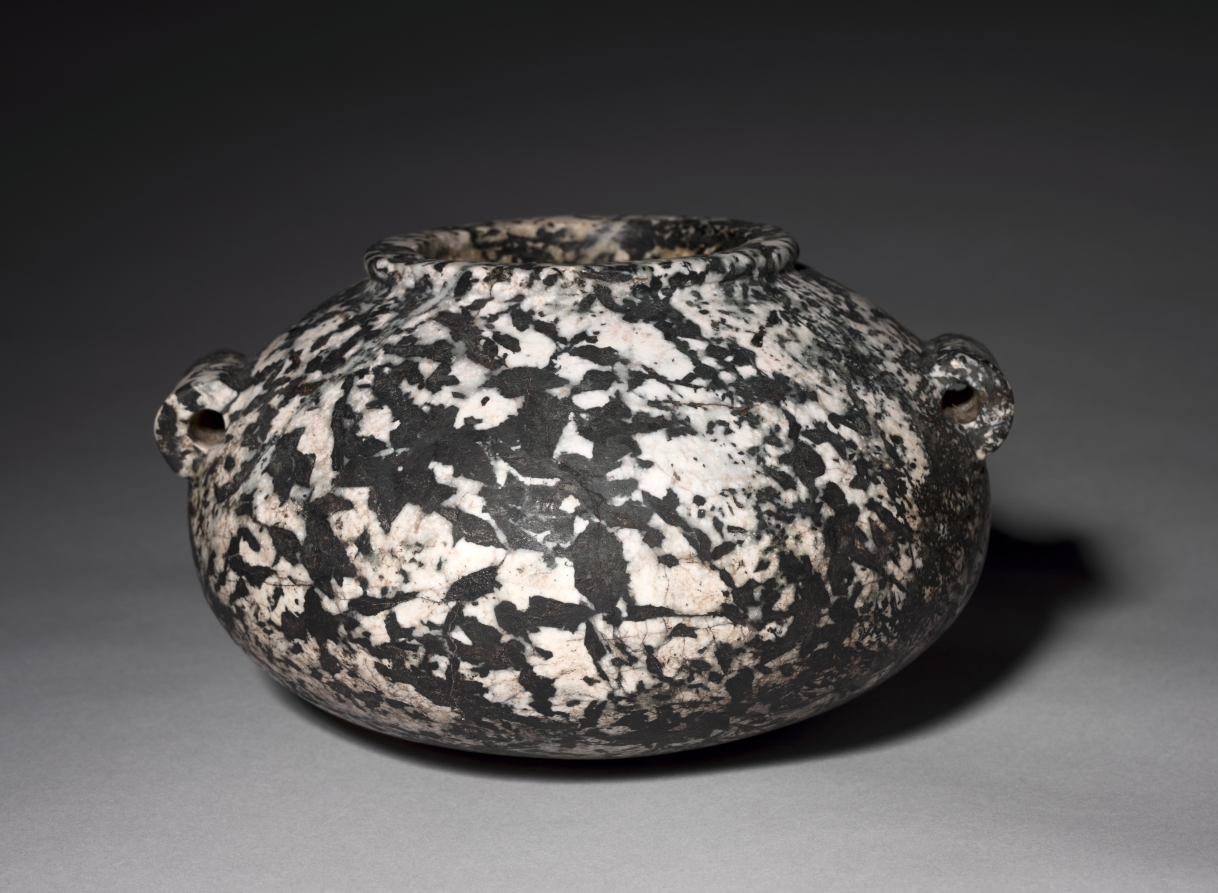
Squat Jar with Lug Handles (2950–2573 BCE) is in the Cleveland Museum of Art collection.
The work and its context
The museum's open-access catalogue describes the work:
A single tomb might contain hundreds of stone vessels replicating the shapes of pottery vessels used in everyday life. The most popular material for stone vessels was white or banded travertine (Egyptian alabaster), found close to the Nile, but prospectors and quarrymen often traveled far in search of the desired materials. The hard stone hornblende diorite, notable for its mottled texture, was quarried in the desert along the route to the Red Sea.
Object facts
- Title: Squat Jar with Lug Handles
- Date: 2950–2573 BCE
- Culture: Egypt, Early Dynastic (2950–2647 BCE), Dynasties 1–3
- Type: Vessels
- Technique: pegmatitic hornblende diorite
- Dimensions: Diameter: 21.1 cm (8 5/16 in.); Diameter of mouth: 8.3 cm (3 1/4 in.); Overall: 13 cm (5 1/8 in.); Diameter of mouth without rim: 8.3 cm (3 1/4 in.)
- Collection: Egypt - Early Dynastic
- Department: Egyptian and Ancient Near Eastern Art
- Accession number: 1914.648
A detail from the museum
The stone used for this vessel, a pegmatitic hornblende diorite whose white crystals contain a faint tint of pink, indicates it must have been considered a luxury item.
Collection credit
Gift of the John Huntington Art and Polytechnic Trust
Further reading listed by the museum
- Kozloff, Arielle P. “Egyptian Stone Vessels in Cleveland.” The Bulletin of the Cleveland Museum of Art 73, no. 8 (October 1986): 327–339.
- Berman, Lawrence M., and Kenneth J. Bohač. Catalogue of Egyptian Art: The Cleveland Museum of Art. Cleveland, OH: Cleveland Museum of Art, 1999
View the collection record
See the museum's photographs and full catalogue entry. Catalogue text is reproduced from the Cleveland Museum of Art's open-access data, with HTML formatting removed. This object and its supplied image are designated CC0.
Sources
More in Lifestyle
Keep reading


