Stand-in Fugen (late 1700s–early 1800s): Art, History and Details
Stand-in Fugen at the Cleveland Museum of Art: late 1700s–early 1800s, hanging scroll; ink and color on silk. Explore the work's context, creator attribution and collection history.
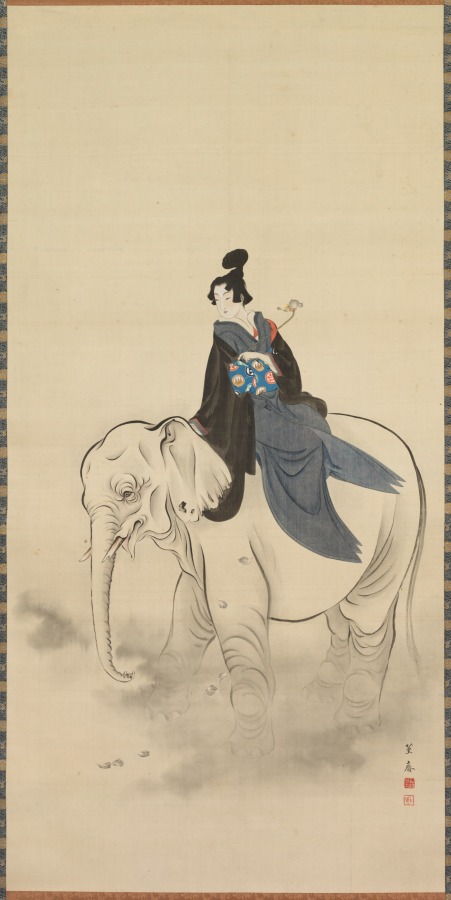
Stand-in Fugen (late 1700s–early 1800s) is in the Cleveland Museum of Art collection. The museum's creator attribution is Kitao Masayoshi (Japanese, 1761–1824).
The work and its context
The museum's open-access catalogue describes the work:
Here, a woman dressed as a man replaces Fugen, a bodhisattva—a being among those considered enlightened in Buddhism—who symbolizes learning as a path to awakening and typically rides an elephant. The painting teaches the lesson of impermanence through the petals falling from the lotus flower the woman holds. It also alludes to the legend of Eguchi, a 12th-century courtesan who, following an encounter with a Buddhist monk-poet called Saigyō, revealed herself to be a manifestation of Fugen.
Object facts
- Title: Stand-in Fugen
- Date: late 1700s–early 1800s
- Creator attribution: Kitao Masayoshi (Japanese, 1761–1824)
- Culture: Japan, Edo period (1615–1868)
- Type: Painting
- Technique: hanging scroll; ink and color on silk
- Dimensions: Painting only: 114.3 x 56.2 cm (45 x 22 1/8 in.); Including mounting: 186.7 x 76.2 cm (73 1/2 x 30 in.)
- Collection: ASIAN - Hanging scroll
- Department: Japanese Art
- Accession number: 1985.277
Collection credit
The Kelvin Smith Collection, given by Mrs. Kelvin Smith
Further reading listed by the museum
- “Checklist of the Kelvin Smith Bequest.” The Bulletin of the Cleveland Museum of Art 75, no. 7 (September 1988): 292–295.
- Koyama-Richard, Brigitte. Animaux Dans La Peinture Japonaise. Lyon: Nouvelles éditions Scala, 2020.
View the collection record
See the museum's photographs and full catalogue entry. Catalogue text is reproduced from the Cleveland Museum of Art's open-access data, with HTML formatting removed. This object and its supplied image are designated CC0.
Sources
More in Lifestyle
Keep reading