Standing Amitabha (800s): Art, History and Details
Standing Amitabha at the Cleveland Museum of Art: 800s, gilt bronze. Explore the work's context, creator attribution and collection history.
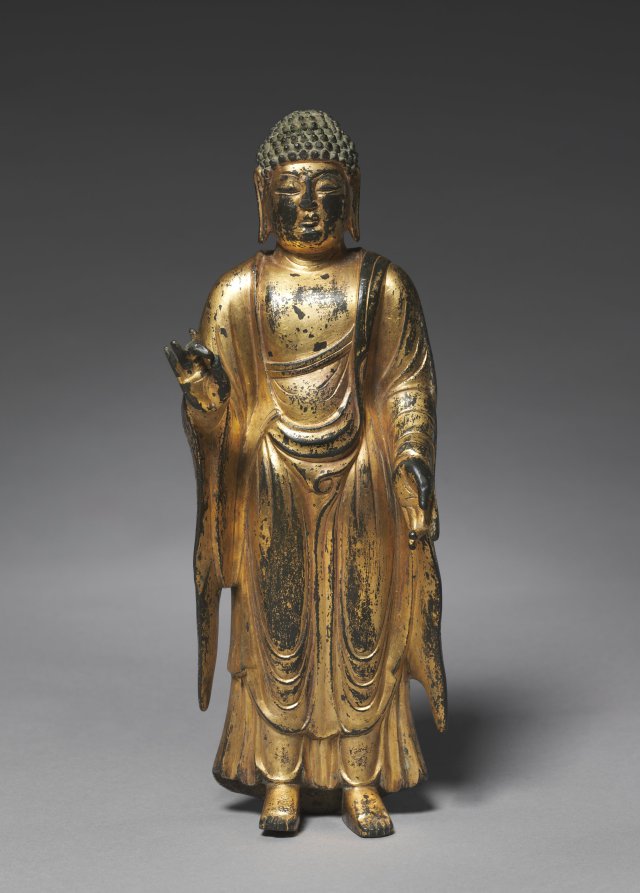
Standing Amitabha (800s) is in the Cleveland Museum of Art collection.
The work and its context
The museum's open-access catalogue describes the work:
Buddhist teachings emphasize the pursuit of spirituality, rather than physicality, to achieve enlightenment. This statue’s artist, however, made genuine efforts to represent the divine’s beautiful voluminous body. Inspired by Indian Gupta period art (300s–500s CE), this particular artistic style emphasizing soft modeling and naturalism was further developed in China and flourished across East Asia.
Object facts
- Title: Standing Amitabha
- Date: 800s
- Culture: Korea, Unified Silla period (676-935)
- Type: Sculpture
- Technique: gilt bronze
- Dimensions: Overall: 25.4 cm (10 in.); with tang: 26 cm (10 1/4 in.)
- Collection: Korean Art
- Department: Korean Art
- Accession number: 1988.34
A detail from the museum
This Korean statue has a stylistic affinity with statues from the Indian Gupta period (300s–500s CE) that emphasize soft modeling and naturalism.
Collection credit
Leonard C. Hanna Jr. Fund
Further reading listed by the museum
- “The Year in Review for 1988.” The Bulletin of the Cleveland Museum of Art 76, no. 2 (February 1989): 30–75.
- Kang, U-bang. Hangung bulgyo jogang ui heureum [한국 불교 조각 의 흐름]. Soeul: Daewonsa, 1995.
- Cleveland Museum of Art, and Michael R. Cunningham. Masterworks of Asian Art. Cleveland: Cleveland Museum of Art, Cleveland: Cleveland Museum of Art; New York: Thames and Hudson, 1998.
View the collection record
See the museum's photographs and full catalogue entry. Catalogue text is reproduced from the Cleveland Museum of Art's open-access data, with HTML formatting removed. This object and its supplied image are designated CC0.
Sources
More in Lifestyle
Keep reading