Stater: Three-Petal Flower (obverse); Horse and wheels (reverse) (20 BCE–10 CE): Art, History and Details
Stater: Three-Petal Flower (obverse); Horse and wheels (reverse) at the Cleveland Museum of Art: 20 BCE–10 CE, gold. Explore the work's context, creator attribution and collection history.
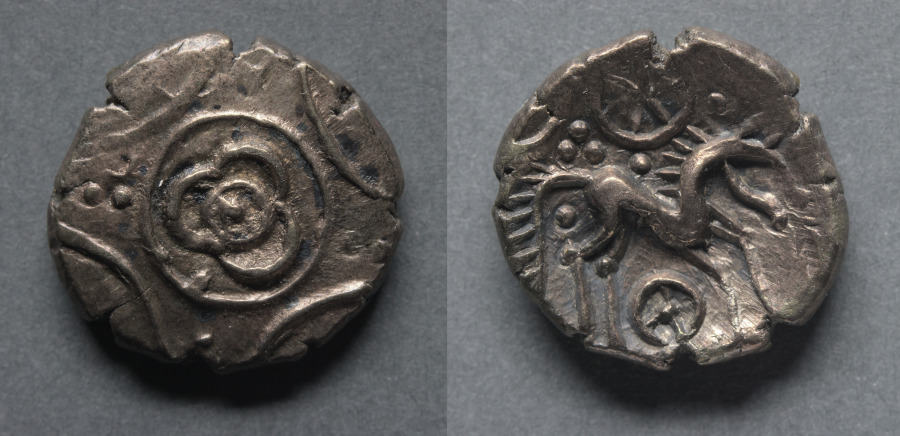
Stater: Three-Petal Flower (obverse); Horse and wheels (reverse) (20 BCE–10 CE) is in the Cleveland Museum of Art collection.
The work and its context
The museum's open-access catalogue describes the work:
The Iceni were a native tribe inhabiting Norfolk, Suffolk, and parts of Cambridgeshire. They were described by the Romans as powerful, unbroken by war. In AD 61 the king of the Iceni, Prasutagus, died, leaving his apparently considerable wealth to his two daughters and to the Roman Emperor, as joint heirs. However, while the Roman legions under Aulus Plautius were in Wales taking drastic steps to exterminate Druidism, Boadicea, the widow of Prasutagus, was ill-treated by the Romans and her two daughters were outraged. The Iceni rose in revolt and helped by their neighbors the Trinovantes, they overran the Roman settlements. It is said that 70,000 Romans were massacred at Camulodunum, and the Iceni, with Boadicea in a war chariot at their head, sacked and burned Verulamium (St. Albans, Hertfordshire), and London. Suetonius, one of the leading Roman generals, returned from the west with all possible speed and came up with the Iceni in the northwest of Roman London. Here a great battle was fought, resulting in a complete victory for the disciplined Roman forces; thousands of Britons were killed. The site of this battle is supposed to have been near what is now Kings Cross, in central London, commemorated by Battle Bridge Road.
Object facts
- Title: Stater: Three-Petal Flower (obverse); Horse and wheels (reverse)
- Date: 20 BCE–10 CE
- Culture: England, Iceni
- Type: Coins
- Technique: gold
- Dimensions: Diameter: 1.9 cm (3/4 in.)
- Collection: MED - Numismatics
- Department: Medieval Art
- Accession number: 1969.156
A detail from the museum
The obverse design may be a rose, a flower that appears on many earlier, mostly Greek, coins.
Collection credit
The Norweb Collection
Further reading listed by the museum
- Cleveland Museum of Art, and Emery May Norweb. English Gold Coins, Ancient to Modern Times, On Loan to the Cleveland Museum of Art from the Norweb Collection. 1968.
- Emery May Norweb Collection (Cleveland, Ohio), Emery May Norweb, C. E. Blunt, F. Elmore Jones, and R. P. Mack. Collection of Ancient British, Romano-British and English Coins. London: Spink, 1971.
View the collection record
See the museum's photographs and full catalogue entry. Catalogue text is reproduced from the Cleveland Museum of Art's open-access data, with HTML formatting removed. This object and its supplied image are designated CC0.
Sources
More in Lifestyle
Keep reading