Tambour Desk (c. 1800): Art, History and Details
Tambour Desk at the Cleveland Museum of Art: c. 1800, mahogany, brass and enamel pulls. Explore the work's context, creator attribution and collection history.
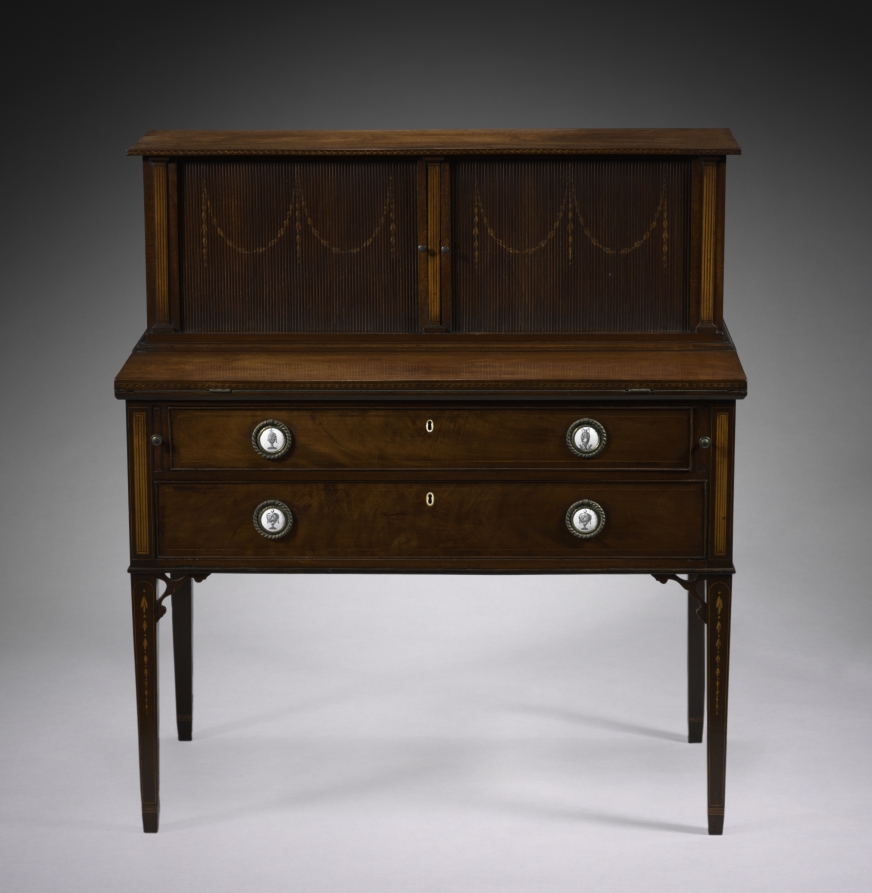
Tambour Desk (c. 1800) is in the Cleveland Museum of Art collection. The museum's creator attribution is John Seymour (American, 1738–1818); Thomas Seymour (American, 1771–1848).
The work and its context
The museum's open-access catalogue describes the work:
The severely rectilinear form, delicate inlay, sliding tambour doors, and blue-painted interior of this small desk relate it to the work of the English-born cabinetmaker John Seymour and his son, Thomas, who were in partnership in Boston during the years around 1800. The Seymours made some of the most sophisticated American furniture in the Hepplewhite style, so-called from the Englishman whose publication of furniture designs was widely influential on both sides of the Atlantic.
Object facts
- Title: Tambour Desk
- Date: c. 1800
- Creator attribution: John Seymour (American, 1738–1818); Thomas Seymour (American, 1771–1848)
- Culture: America, Boston, early 19th Century
- Type: Furniture and woodwork
- Technique: mahogany, brass and enamel pulls
- Dimensions: Overall: 105.4 x 96 x 49.9 cm (41 1/2 x 37 13/16 x 19 5/8 in.)
- Collection: Furniture
- Department: Decorative Art and Design
- Accession number: 1987.11
Collection credit
Leonard C. Hanna Jr. Fund
Further reading listed by the museum
- Turner, Evan H. “The Year in Review for 1987.” The Bulletin of the Cleveland Museum of Art 75, no. 2 (February 1988): 30–71.
View the collection record
See the museum's photographs and full catalogue entry. Catalogue text is reproduced from the Cleveland Museum of Art's open-access data, with HTML formatting removed. This object and its supplied image are designated CC0.
Sources
More in Lifestyle
Keep reading