Tapestry-woven Yoke from a Tunic (800–1200?): Art, History and Details
Tapestry-woven Yoke from a Tunic at the Cleveland Museum of Art: 800–1200?, camelid fiber and cotton, tapestry weave. Explore the work's context, creator attribution and collection history.
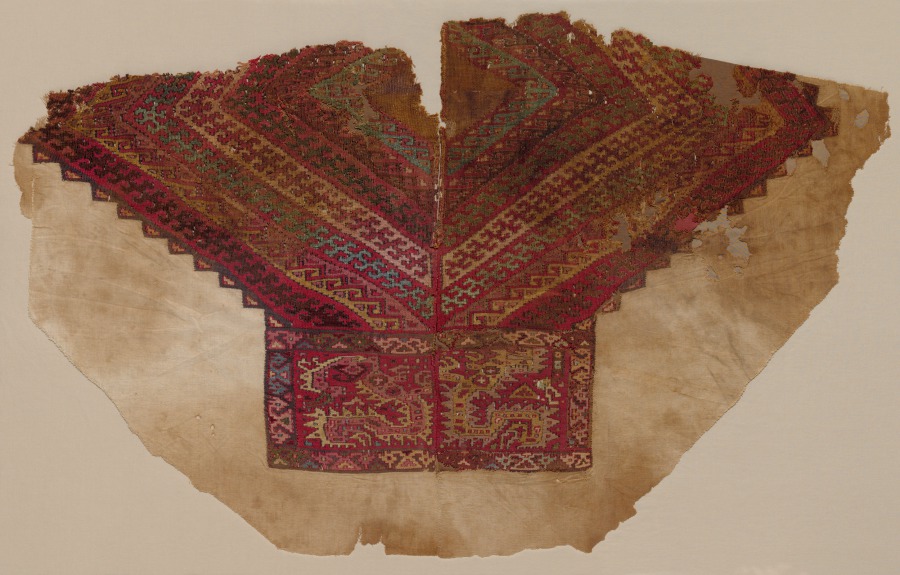
Tapestry-woven Yoke from a Tunic (800–1200?) is in the Cleveland Museum of Art collection.
The work and its context
The museum's open-access catalogue describes the work:
This fragment comes from the upper area of a tunic, with thick embroidery defining remnants of the neck opening. In the rectangular area on the chest are two similar long-tailed creatures rendered in a highly geometric style. Each is rotated 90 degrees, so their tails are parallel to the bottom edge. The cloven hooves on their upper legs may identify the creatures as deer or Andean camelids, such as llamas or alpacas.
Object facts
- Title: Tapestry-woven Yoke from a Tunic
- Date: 800–1200?
- Culture: Central Andes, North Central Coast, Moche-Wari Style
- Type: Textile
- Technique: camelid fiber and cotton, tapestry weave
- Dimensions: Overall: 64.8 x 102.8 cm (25 1/2 x 40 1/2 in.); Mounted: 69.2 x 108 cm (27 1/4 x 42 1/2 in.)
- Collection: Textiles
- Department: Textiles
- Accession number: 1925.667
Collection credit
Purchase from the J. H. Wade Fund
View the collection record
See the museum's photographs and full catalogue entry. Catalogue text is reproduced from the Cleveland Museum of Art's open-access data, with HTML formatting removed. This object and its supplied image are designated CC0.
Sources
More in Lifestyle
Keep reading