Teabowl from Teabowls with Peony and Crabapple (1893–1914): Art, History and Details
Teabowl from Teabowls with Peony and Crabapple at the Cleveland Museum of Art: 1893–1914, One from a set of five teabowls; porcelain with underglaze and overglaze color enamels and gold. Explore the work's context, creator attribution and c
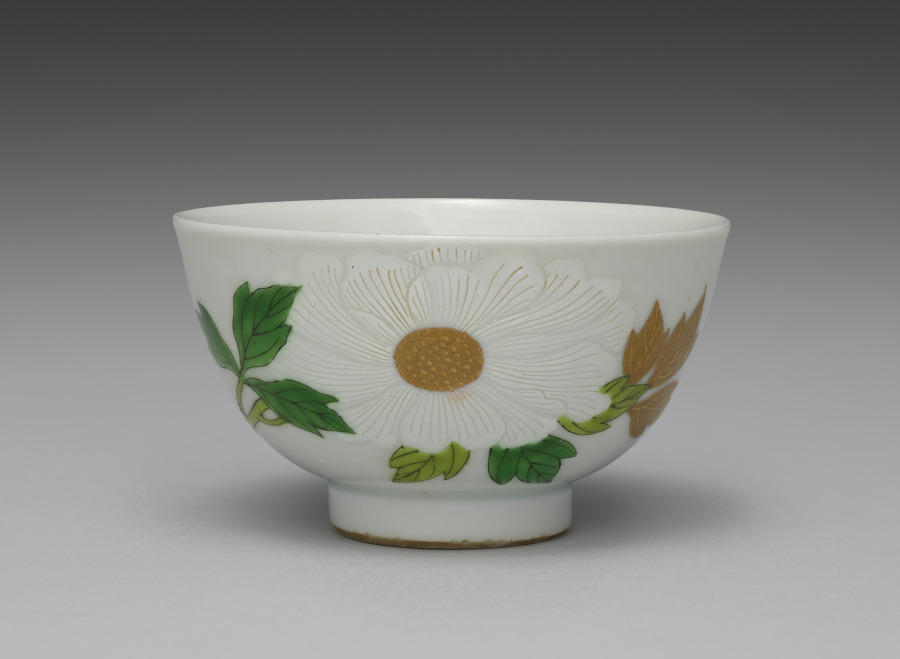
Teabowl from Teabowls with Peony and Crabapple (1893–1914) is in the Cleveland Museum of Art collection. The museum's creator attribution is Seifū Yohei III (Japanese, 1851–1914).
The work and its context
The museum's open-access catalogue describes the work:
Overglaze color enamels are generally called iro-e (literally “color picture”) in the terminology customarily used for porcelain decoration of the Edo period. This set of teabowls is a fine example of Yohei III’s skilled use of the technique, which is identified on this set’s box lid with the alternate phrasing “porcelain with color painting” (jisaiga). Distinct from the way overglaze colors were used in Kakiemon ware from Arita, his designs and applications show a consciousness of porcelain decoration of the Qing dynasty. Here, he combines Chinese models with a sensibility taken from Kyoto ware precedents, including painting with powdered gold (kinrande). The colors used in the bowls are as follows: blue, black, gold, white, light green, green, and pink. The blue appears only inside the footring, as a double band of underglaze color. The black iron, used for stems and leaf veins, is painted over the glaze. The gold, also painted over the glaze, is used for leaves and the centers of flowers, for solid, glossy lines defining detail, or as a semimatte ground. The white of the peony flower is built up to a low relief over the glaze. Yohei has incised lines of varying widths into the pigment, carving away to the bowl’s surface, to differentiate individual petals and their rippled shapes. The light and dark greens, as well as the pink, are painted over the glaze. Of note is how Yohei has first used thinly applied lines of light green to draw the plum branch before applying the opaque iron black. For the plum buds and flowers, he has used a diluted pink with an opaque pink for outline, both over the glaze. In his later works, Yohei used pink both over and under the glaze in a manner similar to underglaze blue, and it can be challenging in some cases to discern which technique he has used. A lidded container in a private collection has a similar design but is augmented with the inclusion of white and purple magnolia blossoms. In contemplating the original decorative program of a set, of which these teabowls may have been a part, it is worth considering that perhaps not all objects included the full range of motifs. In such cases, the composition of the individual object may be best understood within the context of the extended ensemble. Here, the delicate pink plum on one side of the bowl seems slightly unbalanced with the bold white peony on the other, but when seen with other objects with the magnolia and its additional colors and shapes, it is possible to imagine a set with a complex, balanced design across multiple pieces.
Object facts
- Title: Teabowl from Teabowls with Peony and Crabapple
- Date: 1893–1914
- Creator attribution: Seifū Yohei III (Japanese, 1851–1914)
- Culture: Japan, Meiji period (1868–1912)
- Type: Ceramic
- Technique: One from a set of five teabowls; porcelain with underglaze and overglaze color enamels and gold
- Dimensions: Overall: 5 x 8 cm (1 15/16 x 3 1/8 in.)
- Collection: Japanese Art
- Department: Japanese Art
- Accession number: 2022.186.5
A detail from the museum
"Seifū" is inscribed on the base in a double band of underglaze color.
Collection credit
Gift of James and Christine Heusinger
Further reading listed by the museum
- Maezaki, Shinya and Sinéad Vilbar. Colors of Kyoto: The Seifū Yohei Ceramic Studio. Cleveland, OH: The Cleveland Museum of Art, 2023.
View the collection record
See the museum's photographs and full catalogue entry. Catalogue text is reproduced from the Cleveland Museum of Art's open-access data, with HTML formatting removed. This object and its supplied image are designated CC0.
Sources
More in Lifestyle
Keep reading