Thangka with the Seventh Bodhisattva (1368–1424): Art, History and Details
Thangka with the Seventh Bodhisattva at the Cleveland Museum of Art: 1368–1424, Silk and gold thread on silk satin ground, embroidery. Explore the work's context, creator attribution and collection history.
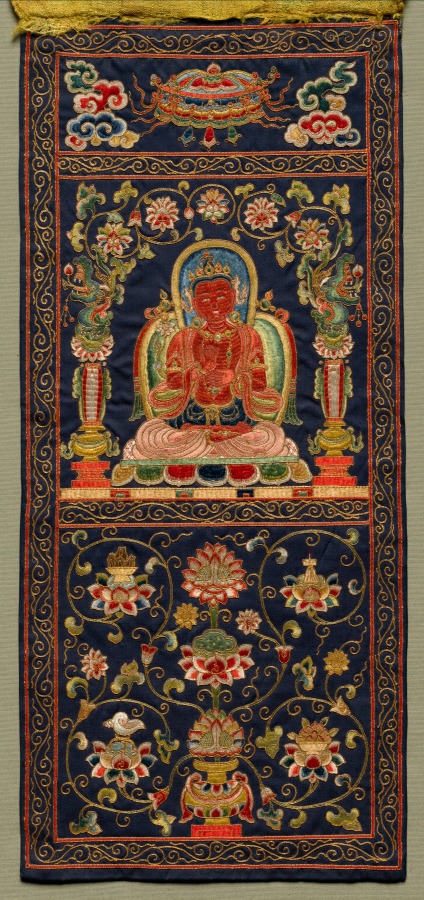
Thangka with the Seventh Bodhisattva (1368–1424) is in the Cleveland Museum of Art collection.
The work and its context
The museum's open-access catalogue describes the work:
In remarkably pristine condition, this embroidery is from a dispersed set that included images of protectors and bodhisattvas. The embroidery technique and pictorial style are Chinese, but the subject matter and the type of devotional hanging called a thangka are associated with Tibetan Buddhism. Historical records state that during the early Ming dynasty (1368–1644), gifts of Buddhist art were sent from China to Tibet, since relationships between Chinese rulers and Tibetan monastic patriarchs were strong and amicable during this time. A Tibetan inscription on the back notes that this figure is the “seventh bodhisattva,” indicating the position in which it would have hung in a temple hall. Odd-numbered works were hung on one side of the main image, and even-numbered works on the other, counting from the center.
Object facts
- Title: Thangka with the Seventh Bodhisattva
- Date: 1368–1424
- Culture: China, Ming dynasty (1368–1644)
- Type: Embroidery
- Technique: Silk and gold thread on silk satin ground, embroidery
- Dimensions: Overall: 43.8 x 19.5 cm (17 1/4 x 7 11/16 in.); Mounted: 56.8 x 31.8 cm (22 3/8 x 12 1/2 in.)
- Collection: Textiles
- Department: Textiles
- Accession number: 1991.2
A detail from the museum
The bodhisattva is flanked by two columns, each topped with a makara, a fanciful water creature whose tail becomes lotus scrolls forming an arch over the bodhisattva.
Collection credit
Purchase from the J. H. Wade Fund
Further reading listed by the museum
- Turner, Evan H. "Selected 1991 Acquisitions." The Bulletin of the Cleveland Museum of Art 79, no. 2 (1992): 63-83.
- Wilson, J. Keith, and Anne E. Wardwell. "New Objects/New Insights: Cleveland's Recent Chinese Acquisitions." The Bulletin of the Cleveland Museum of Art 81, no. 8 (1994): 270-347.
- Watt, James C. Y., Anne E. Wardwell, and Morris Rossabi. When silk was gold: Central Asian and Chinese textiles. New York: Metropolitan Museum of Art in cooperation with the Cleveland Museum of Art, 1997.
View the collection record
See the museum's photographs and full catalogue entry. Catalogue text is reproduced from the Cleveland Museum of Art's open-access data, with HTML formatting removed. This object and its supplied image are designated CC0.
Sources
More in Lifestyle
Keep reading