The Alchymist, in Search of the Philosopher's Stone, Discovers Phosphorus, and Prays for the Successful Conclusion of his Operation, as was the Custom of the Ancient Chymical Astrologers (1775): Art,
The Alchymist, in Search of the Philosopher's Stone, Discovers Phosphorus, and Prays for the Successful Conclusion of his Operation, as was the Custom of the Ancient Chymical Astrologers at the Cleveland Museum of Art: 1775, mezzotint. Expl
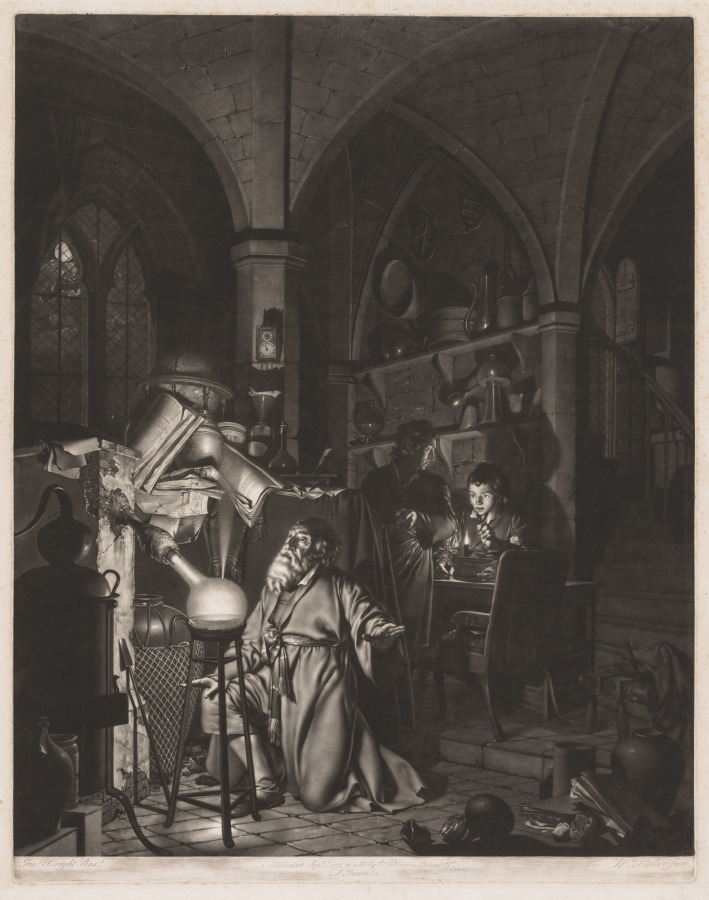
The Alchymist, in Search of the Philosopher's Stone, Discovers Phosphorus, and Prays for the Successful Conclusion of his Operation, as was the Custom of the Ancient Chymical Astrologers (1775) is in the Cleveland Museum of Art collection. The museum's creator attribution is William Pether (British, c. 1738–1821); Joseph Wright of Derby (British, 1734–1797).
The work and its context
The museum's open-access catalogue describes the work:
The print’s title and the medieval-looking interior filled with instruments identify the kneeling figure as an alchemist, someone who seeks the philosopher’s stone, a mythic substance that was thought to transform ordinary metals into gold and reverse the aging process. Here, the alchemist’s experiments accidentally lead him to discover the chemical element phosphorus, seen glowing in the flask before him. In choosing this moment of illumination, the artist crafted a potent allegory of the Enlightenment in which the creative force of imagination becomes true knowledge through reason and observation.
Object facts
- Title: The Alchymist, in Search of the Philosopher's Stone, Discovers Phosphorus, and Prays for the Successful Conclusion of his Operation, as was the Custom of the Ancient Chymical Astrologers
- Date: 1775
- Creator attribution: William Pether (British, c. 1738–1821); Joseph Wright of Derby (British, 1734–1797)
- Culture: England, 18th century
- Type: Print
- Technique: mezzotint
- Dimensions: Image: 56.1 x 45.5 cm (22 1/16 x 17 15/16 in.); Plate: 58 x 45.6 cm (22 13/16 x 17 15/16 in.); Sheet: 64.6 x 50.7 cm (25 7/16 x 19 15/16 in.)
- Collection: PR - Mezzotint
- Department: Prints
- Accession number: 1995.2
A detail from the museum
Joseph Wright of Derby’s composition was based on the story of Hennig Brand, the German alchemist who accidentally discovered phosphorus in 1676.
Collection credit
Alma and Robert D. Milne Fund
View the collection record
See the museum's photographs and full catalogue entry. Catalogue text is reproduced from the Cleveland Museum of Art's open-access data, with HTML formatting removed. This object and its supplied image are designated CC0.
Sources
More in Lifestyle
Keep reading
Related stories