The astrologer predicts a calamity for the newly born prince in his thirteenth year, but one which he would be able to overcome, from a Tuti-nama (Tales of a Parrot): Eighth Night (c. 1560): Art, Hist
The astrologer predicts a calamity for the newly born prince in his thirteenth year, but one which he would be able to overcome, from a Tuti-nama (Tales of a Parrot): Eighth Night at the Cleveland Museum of Art: c. 1560, gum tempera, ink, a
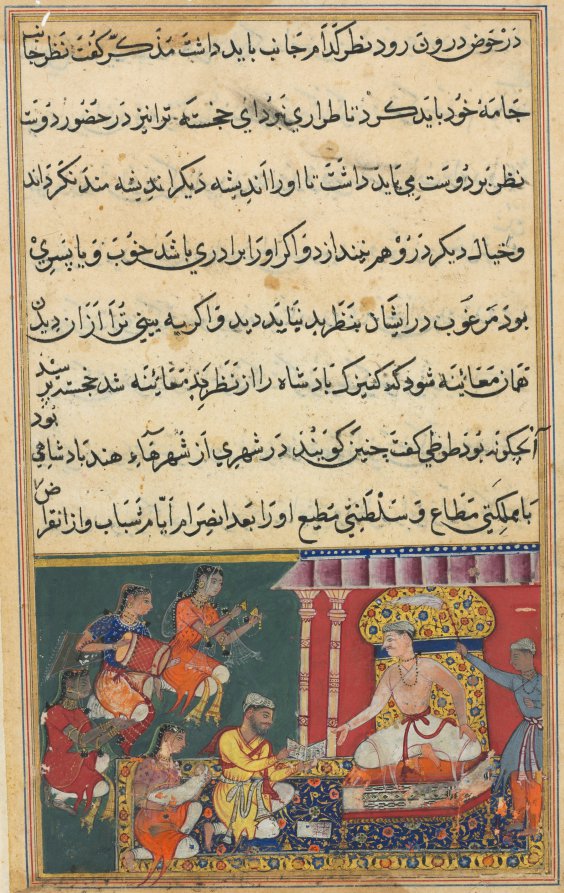
The astrologer predicts a calamity for the newly born prince in his thirteenth year, but one which he would be able to overcome, from a Tuti-nama (Tales of a Parrot): Eighth Night (c. 1560) is in the Cleveland Museum of Art collection. The museum's creator attribution is Banavari 1 (Indian, active 1550s-1590s).
The work and its context
The museum's open-access catalogue describes the work:
The parrot’s tale on the eighth night begins with a king in India who finally had a son late in life. The painting depicts the king enthroned, gesturing to the documents of an astrologer who has predicted that the child will undergo severe hardship in his 13th year, but that he will overcome them. The infant prince is held in the arms of a woman kneeling at the left. Female musicians provide accompaniment to the scene. The flat red background, drawn from indigenous Indian painting traditions, visually connotes the emotionally charged quality of this moment for the king.
Object facts
- Title: The astrologer predicts a calamity for the newly born prince in his thirteenth year, but one which he would be able to overcome, from a Tuti-nama (Tales of a Parrot): Eighth Night
- Date: c. 1560
- Creator attribution: Banavari 1 (Indian, active 1550s-1590s)
- Culture: Mughal India, court of Akbar (reigned 1556–1605)
- Type: Painting
- Technique: gum tempera, ink, and gold on paper
- Dimensions: Overall: 20.3 x 14 cm (8 x 5 1/2 in.); Painting only: 6.3 x 9.9 cm (2 1/2 x 3 7/8 in.)
- Collection: Indian Art
- Department: Indian and Southeast Asian Art
- Accession number: 1962.279.52.b
A detail from the museum
The bearded astrologer has a chart with calculations on the carpet in front of him.
Collection credit
Gift of Mrs. A. Dean Perry
Further reading listed by the museum
- Chandra, Pramod, and Daniel J. Ehnbom. The Cleveland Tuti-Nama Manuscript and the Origins of Mughal Painting. [Cleveland]: Cleveland Museum of Art, 1976.
- Seyller, John. “Overpainting in the Cleveland T̤ūtīnāma.” Artibus Asiae 52, no. 3/4 (1992): 283-318.
View the collection record
See the museum's photographs and full catalogue entry. Catalogue text is reproduced from the Cleveland Museum of Art's open-access data, with HTML formatting removed. This object and its supplied image are designated CC0.
Sources
More in Lifestyle
Keep reading