The Bacchanal (c.1490–1536): Art, History and Details
The Bacchanal at the Cleveland Museum of Art: c.1490–1536, etching. Explore the work's context, creator attribution and collection history.
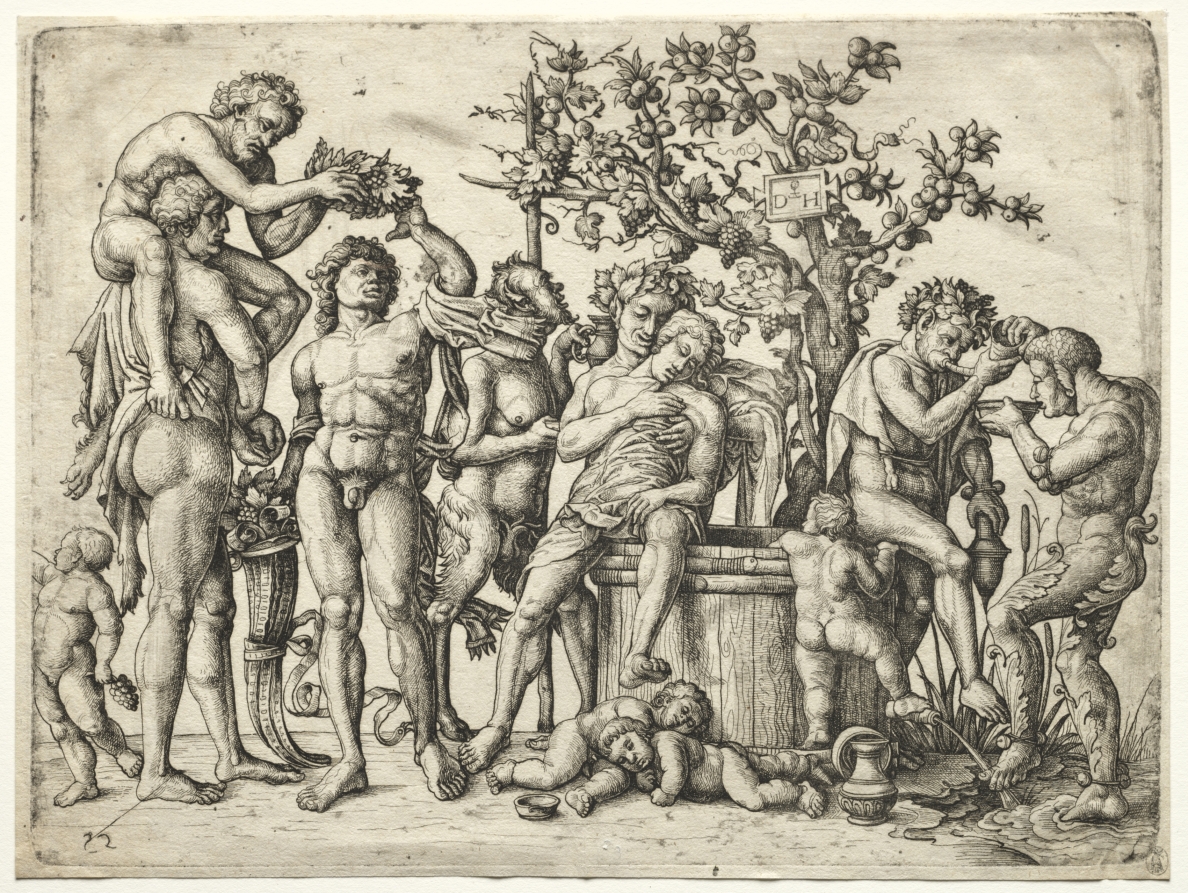
The Bacchanal (c.1490–1536) is in the Cleveland Museum of Art collection. The museum's creator attribution is Daniel Hopfer (German, c. 1470–1536); Andrea Mantegna (Italian, about 1431–1506).
The work and its context
The museum's open-access catalogue describes the work:
Andrea Mantegna was among the first artists in Italy to produce engravings. His scene of a bacchanalia, a wine-fueled festival of ancient Rome, is composed as if on a shallow stage, attesting to Mantegna’s interest in relief-carved Roman sarcophagi (stone coffins). Standing with his horn of plenty, Bacchus is in control of his senses. The mortals around him falter from too much drink. When Mantegna began making engravings in the 1470s, he was among the first to use the technique to reproduce drawings. Many of Mantegna’s engravings show printing imperfections, the result of a shallowly carved printing plate and ink that did not adhere evenly to the paper. The later copy looks quite different. Daniel Hopfer employed the nimbler technique of etching and had access to higher-quality inks and papers.
Object facts
- Title: The Bacchanal
- Date: c.1490–1536
- Creator attribution: Daniel Hopfer (German, c. 1470–1536); Andrea Mantegna (Italian, about 1431–1506)
- Culture: Germany
- Type: Print
- Technique: etching
- Dimensions: Platemark: 21.1 x 28.4 cm (8 5/16 x 11 3/16 in.); Sheet: 21.9 x 29.1 cm (8 5/8 x 11 7/16 in.)
- Collection: PR - Etching
- Department: Prints
- Accession number: 1925.620
A detail from the museum
The ancient Greek philosopher Plato, who was still widely read in the sixteenth century, wrote that wine could enhance creativity and even unlock divine ecstasy.
Collection credit
Dudley P. Allen Fund
Further reading listed by the museum
- Winter, Patrick M. de. “Recent Accessions of Italian Renaissance Decorative Arts, Part I: Incorporating Notes on the Sculptor Severo Da Ravenna.” The Bulletin of the Cleveland Museum of Art 73, no. 3 (March 1986): 74–138. Published as: 1926.460
View the collection record
See the museum's photographs and full catalogue entry. Catalogue text is reproduced from the Cleveland Museum of Art's open-access data, with HTML formatting removed. This object and its supplied image are designated CC0.
Sources
More in Lifestyle
Keep reading