The Bodhisattvas of the Ten Stages in Attaining the Most Perfect Knowledge (1454): Art, History and Details
The Bodhisattvas of the Ten Stages in Attaining the Most Perfect Knowledge at the Cleveland Museum of Art: 1454, hanging scroll; ink and color on silk. Explore the work's context, creator attribution and collection history.
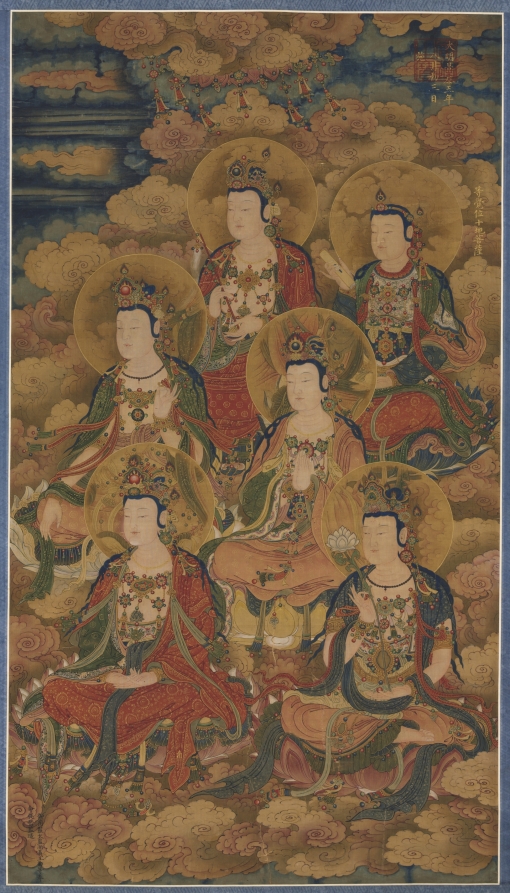
The Bodhisattvas of the Ten Stages in Attaining the Most Perfect Knowledge (1454) is in the Cleveland Museum of Art collection.
The work and its context
The museum's open-access catalogue describes the work:
This painting represents bodhisattvas of the 10 stages of enlightenment undergoing the final processes toward Buddhahood. This and CMA 1973.70.2 form part of a set of scrolls that were used to perform the Water-Land (shuilu) ritual. The sinuous curves of scarf and drapery, the layering of garments, and the minute detail all reflect the opulent visual atmosphere that surrounded the Ming worshipper in temples and spirit halls throughout the country. In the upper right corner of each painting is an imperial seal and an inscription in gold: Donated on the third day of the eighth month in the fifth year of the Jingtai reign (1454) of the Great Ming. Written in ink in the lower left corner is the record that they were made on imperial order, probably to present them to the Da Longfu monastery in Beijing.
Object facts
- Title: The Bodhisattvas of the Ten Stages in Attaining the Most Perfect Knowledge
- Date: 1454
- Culture: China, Ming dynasty (1368–1644)
- Type: Painting
- Technique: hanging scroll; ink and color on silk
- Dimensions: Painting: 140.8 x 79.3 cm (55 7/16 x 31 1/4 in.); Overall with knobs: 227.8 x 120 cm (89 11/16 x 47 1/4 in.)
- Collection: ASIAN - Hanging scroll
- Department: Chinese Art
- Accession number: 1973.70.1
A detail from the museum
This painting was used in the grandest of the Buddhist mortuary rites, the Water-Land (shuilu) ritual, which was conducted for the salvation of “all souls of the dead on land and sea.”
Collection credit
John L. Severance Fund
Further reading listed by the museum
- “The Year in Review for 1973.” The Bulletin of the Cleveland Museum of Art 61, no. 2 (February 1974): 31–78.
- The Cleveland Museum of Art. Handbook of the Cleveland Museum of Art/1978. Cleveland, OH: The Cleveland Museum of Art, 1978.
- Ho, Wai-kam, Sherman E. Lee, Laurence Sickman, and Marc F. Wilson. Eight Dynasties of Chinese Painting: The Collections of the Nelson Gallery-Atkins Museum, Kansas City, and the Cleveland Museum of Art. Cleveland, OH: Cleveland Museum of Art, in cooperation with Indiana University Press, 1980.
View the collection record
See the museum's photographs and full catalogue entry. Catalogue text is reproduced from the Cleveland Museum of Art's open-access data, with HTML formatting removed. This object and its supplied image are designated CC0.
Sources
More in Lifestyle
Keep reading