The Crucifixion (c. 1360s): Art, History and Details
The Crucifixion at the Cleveland Museum of Art: c. 1360s, tempera and gold on wood (walnut). Explore the work's context, creator attribution and collection history.
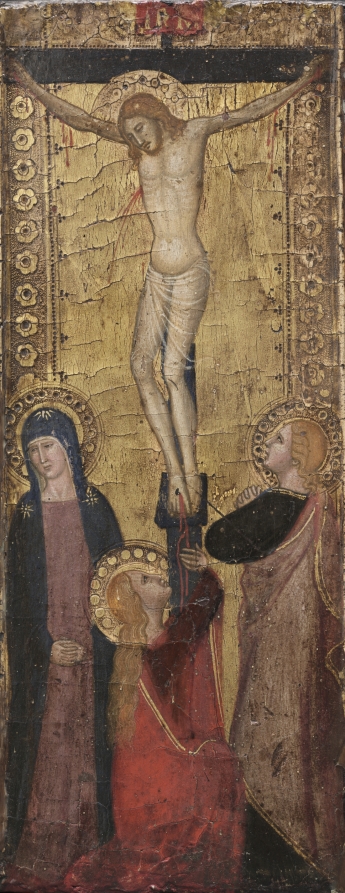
The Crucifixion (c. 1360s) is in the Cleveland Museum of Art collection. The museum's creator attribution is Andrea da Firenze (Italian, 1379).
The work and its context
The museum's open-access catalogue describes the work:
This panel was probably part of a small altarpiece of private devotion. The artist was active in Florence and Siena following the Black Death, which began in the late 1340s. His works, like others created during that troubled time, are charged with emotion.
Object facts
- Title: The Crucifixion
- Date: c. 1360s
- Creator attribution: Andrea da Firenze (Italian, 1379)
- Culture: Italy, Florence
- Type: Painting
- Technique: tempera and gold on wood (walnut)
- Dimensions: Unframed: 31 x 13.4 cm (12 3/16 x 5 1/4 in.)
- Collection: MED - Medieval Art
- Department: Medieval Art
- Accession number: 1916.776
A detail from the museum
This panel has been trimmed slightly at the bottom, cutting off the scene.
Collection credit
Holden Collection
Further reading listed by the museum
- Tartuferi. Angelo 'Andrea da Firenze (i),' in The Dictionary of Art.
- Andrea da Firenze, KhI-Vaticano.
- Works of Art Composing the Collection of Mr. Minor K. Kellogg, American Painter (Paris, 1858).
View the collection record
See the museum's photographs and full catalogue entry. Catalogue text is reproduced from the Cleveland Museum of Art's open-access data, with HTML formatting removed. This object and its supplied image are designated CC0.
Sources
More in Lifestyle
Keep reading


