The donkey, in a tiger’s skin, reveals his identity by braying aloud, from a Tuti-nama (Tales of a Parrot): Thirty-first Night (c. 1560): Art, History and Details
The donkey, in a tiger’s skin, reveals his identity by braying aloud, from a Tuti-nama (Tales of a Parrot): Thirty-first Night at the Cleveland Museum of Art: c. 1560, gum tempera, ink, and gold on paper. Explore the work's context, creator
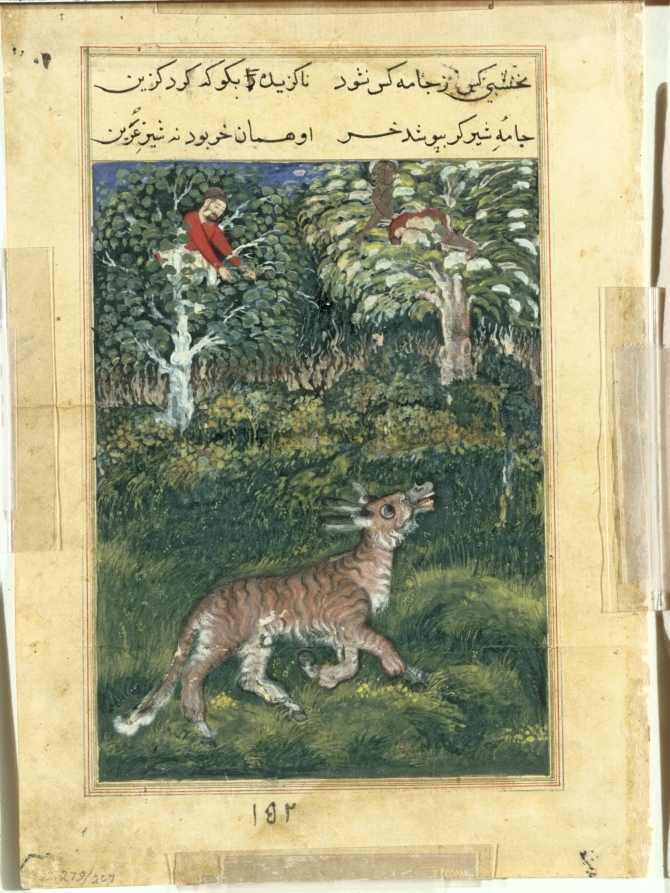
The donkey, in a tiger’s skin, reveals his identity by braying aloud, from a Tuti-nama (Tales of a Parrot): Thirty-first Night (c. 1560) is in the Cleveland Museum of Art collection. The museum's creator attribution is Basavana (Indian, active c. 1560–1600).
The work and its context
The museum's open-access catalogue describes the work:
This painting illustrates a story about a merchant who owned a donkey but did not have enough money to feed him. He was able to secure a tiger’s skin, in which he dressed his donkey at night, so he could forage freely in fields, frightening away the owners’ watchmen, seen here scrambling up in trees for safety. He succeeded for a time and grew fat and healthy, until a nearby donkey brayed, and he instinctively answered, revealing his true identity.
Object facts
- Title: The donkey, in a tiger’s skin, reveals his identity by braying aloud, from a Tuti-nama (Tales of a Parrot): Thirty-first Night
- Date: c. 1560
- Creator attribution: Basavana (Indian, active c. 1560–1600)
- Culture: Mughal India, court of Akbar (reigned 1556–1605)
- Type: Painting
- Technique: gum tempera, ink, and gold on paper
- Dimensions: Overall: 20.3 x 14 cm (8 x 5 1/2 in.); Painting only: 13.8 x 10 cm (5 7/16 x 3 15/16 in.)
- Collection: Indian Art
- Department: Indian and Southeast Asian Art
- Accession number: 1962.279.207.a
A detail from the museum
The complex brushwork, soft grass, and furry tiger’s skin are characteristics of the artist Basavana’s distinctive style.
Collection credit
Gift of Mrs. A. Dean Perry
Further reading listed by the museum
- Chandra, Pramod, and Daniel J. Ehnbom. The Cleveland Tuti-Nama Manuscript and the Origins of Mughal Painting. Cleveland, OH: The Cleveland Museum of Art, 1976.
- Chandra, Pramod, and Daniel J. Ehnbom. The Cleveland Tuti-Nama Manuscript and the Origins of Mughal Painting. [Cleveland]: Cleveland Museum of Art, 1976.
- Nakhshabī, Z̤iyāʼ al-Dīn, and Muhammed Ahmed Simsar, translator and editor. Tales of a Parrot = The Cleveland Museum of Art's Ṭūṭīnāma. Cleveland, OH: The Museum, 1978.
View the collection record
See the museum's photographs and full catalogue entry. Catalogue text is reproduced from the Cleveland Museum of Art's open-access data, with HTML formatting removed. This object and its supplied image are designated CC0.
Sources
More in Lifestyle
Keep reading