The Great Temple of Abu Simbel (before 1943): Art, History and Details
The Great Temple of Abu Simbel at the Cleveland Museum of Art: before 1943, Watercolor and wash, with white highlights. Explore the work's context, creator attribution and collection history.
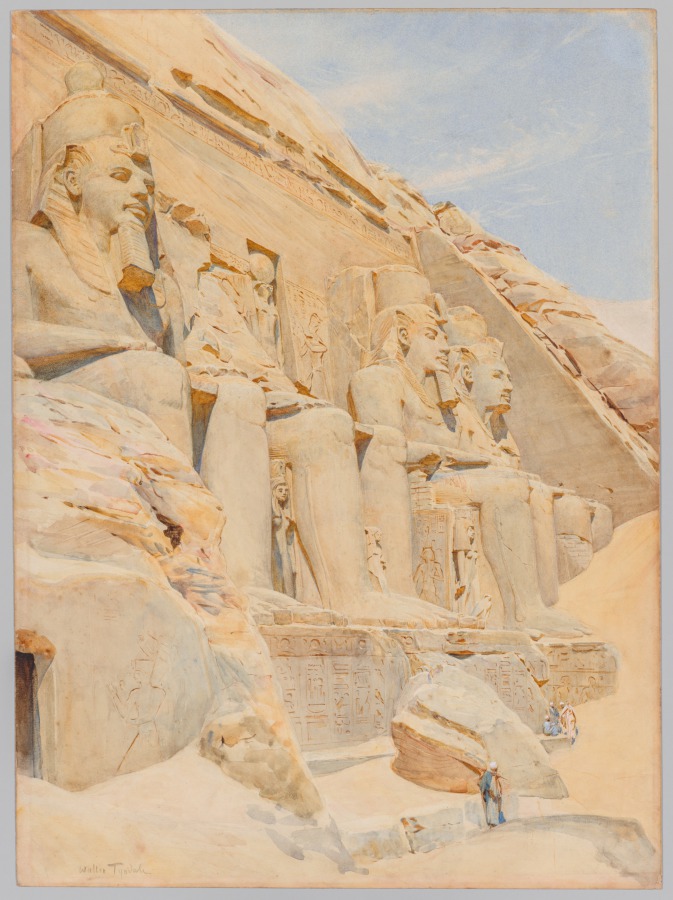
The Great Temple of Abu Simbel (before 1943) is in the Cleveland Museum of Art collection. The museum's creator attribution is Walter Frederick Roofe Tyndale (British, born Belgium, 1855–1943).
The work and its context
The museum's open-access catalogue describes the work:
The British artist Walter Frederick Roofe Tyndale made repeated trips to Egypt beginning in the late 19th century. While there, he was inspired by the Abu Simbel temples, seen in this drawing, which feature relief portraits of Ramses the Great and his queen Nefertari. Here, Tyndale contrasted the massive temple with figures standing before it to give a sense of its epic scale.
Object facts
- Title: The Great Temple of Abu Simbel
- Date: before 1943
- Creator attribution: Walter Frederick Roofe Tyndale (British, born Belgium, 1855–1943)
- Culture: England, 19th-20th century
- Type: Drawing
- Technique: Watercolor and wash, with white highlights
- Dimensions: Sheet: 46.3 x 33.9 cm (18 1/4 x 13 3/8 in.)
- Collection: DR - British
- Department: Drawings
- Accession number: 2018.73
Collection credit
Bequest of William Kelly Simpson
View the collection record
See the museum's photographs and full catalogue entry. Catalogue text is reproduced from the Cleveland Museum of Art's open-access data, with HTML formatting removed. This object and its supplied image are designated CC0.
Sources
More in Lifestyle
Keep reading