The guard spares the life of the slave when he learns that he is the son of the princess of the Rum, from a Tuti-nama (Tales of a Parrot): Fiftieth Night (c. 1560): Art, History and Details
The guard spares the life of the slave when he learns that he is the son of the princess of the Rum, from a Tuti-nama (Tales of a Parrot): Fiftieth Night at the Cleveland Museum of Art: c. 1560, gum tempera, ink, and gold on paper. Explore
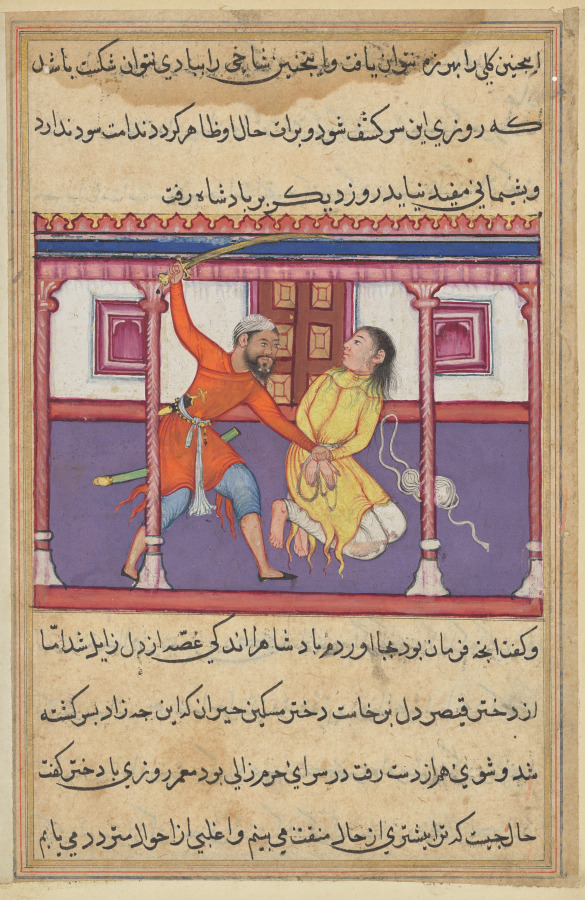
The guard spares the life of the slave when he learns that he is the son of the princess of the Rum, from a Tuti-nama (Tales of a Parrot): Fiftieth Night (c. 1560) is in the Cleveland Museum of Art collection.
The work and its context
The museum's open-access catalogue describes the work:
The king, mistakenly believing that the princess’s secret son is her lover, orders him to be executed. The young man is shown with hands bound and long hair in disarray; his unraveled turban lies on the ground at his side. Just before the guard can behead him, the princess’s son reveals his true identity, and his life is spared.
Object facts
- Title: The guard spares the life of the slave when he learns that he is the son of the princess of the Rum, from a Tuti-nama (Tales of a Parrot): Fiftieth Night
- Date: c. 1560
- Culture: Mughal India, court of Akbar (reigned 1556–1605)
- Type: Painting
- Technique: gum tempera, ink, and gold on paper
- Dimensions: Overall: 20.3 x 14 cm (8 x 5 1/2 in.); Painting only: 7.9 x 10 cm (3 1/8 x 3 15/16 in.)
- Collection: Indian Art
- Department: Indian and Southeast Asian Art
- Accession number: 1962.279.321.b
A detail from the museum
The guard hides the princess’s son and does not reveal his identity to the king.
Collection credit
Gift of Mrs. A. Dean Perry
Further reading listed by the museum
- Chandra, Pramod, and Daniel J. Ehnbom. The Cleveland Tuti-Nama Manuscript and the Origins of Mughal Painting. [Cleveland]: Cleveland Museum of Art, 1976.
View the collection record
See the museum's photographs and full catalogue entry. Catalogue text is reproduced from the Cleveland Museum of Art's open-access data, with HTML formatting removed. This object and its supplied image are designated CC0.
Sources
More in Lifestyle
Keep reading