The hunter throws away the baby parrots, who pretend to be dead, and captures the mother, from a Tuti-nama (Tales of a Parrot): Fifth Night (c. 1560): Art, History and Details
The hunter throws away the baby parrots, who pretend to be dead, and captures the mother, from a Tuti-nama (Tales of a Parrot): Fifth Night at the Cleveland Museum of Art: c. 1560, gum tempera, ink, and gold on paper. Explore the work's con
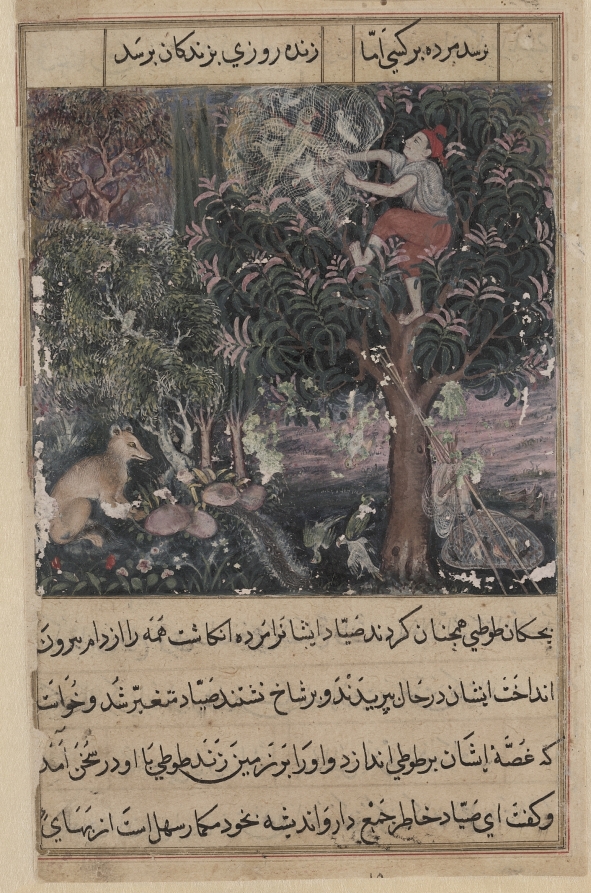
The hunter throws away the baby parrots, who pretend to be dead, and captures the mother, from a Tuti-nama (Tales of a Parrot): Fifth Night (c. 1560) is in the Cleveland Museum of Art collection. The museum's creator attribution is Basavana (Indian, active c. 1560–1600).
The work and its context
The museum's open-access catalogue describes the work:
Despite the chess-playing monkey’s grim end, the baby parrots continued to cavort with the fox cubs. One day the mother fox discovered that her cubs had been eaten by a panther. Blaming the parrots, she lured a hunter to their tree. The hunter climbed the tree and ensnared the mother parrot and her babies. The mother instructed her young to play dead, then pleaded with the hunter to take her alone, saying that since she knew the art of healing she would fetch a high price. Lush vegetation and a stream of water painted with a soft brush indicate a fresh new stylistic vision that represents a departure from Indian and Persian styles that came before.
Object facts
- Title: The hunter throws away the baby parrots, who pretend to be dead, and captures the mother, from a Tuti-nama (Tales of a Parrot): Fifth Night
- Date: c. 1560
- Creator attribution: Basavana (Indian, active c. 1560–1600)
- Culture: Mughal India, court of Akbar (reigned 1556–1605)
- Type: Painting
- Technique: gum tempera, ink, and gold on paper
- Dimensions: Overall: 20 x 14.4 cm (7 7/8 x 5 11/16 in.); Painting only: 10.6 x 10.2 cm (4 3/16 x 4 in.)
- Collection: Indian Art
- Department: Indian and Southeast Asian Art
- Accession number: 1962.279.35.a
A detail from the museum
The pink leaves are new shoots that have not yet turned green.
Collection credit
Gift of Mrs. A. Dean Perry
Further reading listed by the museum
- Chandra, Pramod, and Daniel J. Ehnbom. The Cleveland Tuti-Nama Manuscript and the Origins of Mughal Painting. [Cleveland]: Cleveland Museum of Art, 1976.
- Seyller, John. “Overpainting in the Cleveland T̤ūtīnāma.” Artibus Asiae 52, no. 3/4 (1992): 283-318.
View the collection record
See the museum's photographs and full catalogue entry. Catalogue text is reproduced from the Cleveland Museum of Art's open-access data, with HTML formatting removed. This object and its supplied image are designated CC0.
Sources
More in Lifestyle
Keep reading