The Mausoleum of Akbar at Secundrabad (early 1800s): Art, History and Details
The Mausoleum of Akbar at Secundrabad at the Cleveland Museum of Art: early 1800s, watercolor on paper. Explore the work's context, creator attribution and collection history.
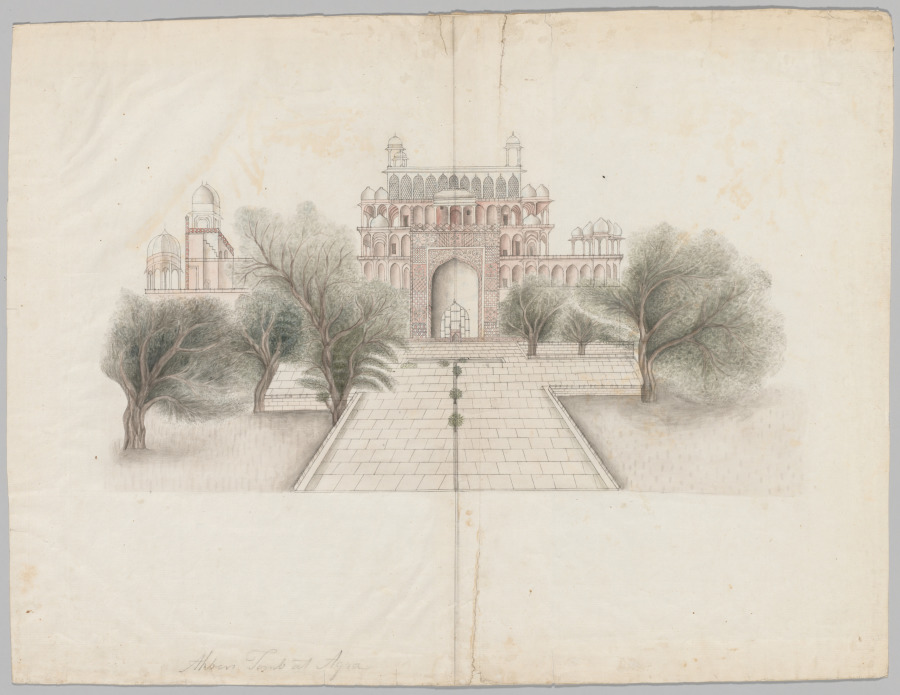
The Mausoleum of Akbar at Secundrabad (early 1800s) is in the Cleveland Museum of Art collection.
The work and its context
The museum's open-access catalogue describes the work:
Before the invention of photography, British travelers in India collected watercolor sketches of monuments and picturesque scenes. This tomb near Agra marks the burial place of one of India’s most illustrious rulers, the Mughal emperor Akbar (1542–1605). In reality it is dominating in scale and ornamented with complex geometric and floral motifs articulated in multicolored stone inlays, relief carvings, and paintings. In this sketch, the site has been rendered in the muted tones that appealed to British taste of the time, and its ornament has been reduced and simplified, giving little indication of its grandeur.
Object facts
- Title: The Mausoleum of Akbar at Secundrabad
- Date: early 1800s
- Culture: India, Company School, early 19th century
- Type: Drawing
- Technique: watercolor on paper
- Dimensions: Overall: 45.7 x 60.3 cm (18 x 23 3/4 in.)
- Collection: Indian Art
- Department: Indian and Southeast Asian Art
- Accession number: 1983.115
Collection credit
Gift of Mr. and Mrs. William E. Ward in memory of his parents, Lura and Edward Ward
View the collection record
See the museum's photographs and full catalogue entry. Catalogue text is reproduced from the Cleveland Museum of Art's open-access data, with HTML formatting removed. This object and its supplied image are designated CC0.
Sources
More in Lifestyle
Keep reading