The Optical Viewer (c. 1793): Art, History and Details
The Optical Viewer at the Cleveland Museum of Art: c. 1793, Chalk-manner etching and engraving. Explore the work's context, creator attribution and collection history.
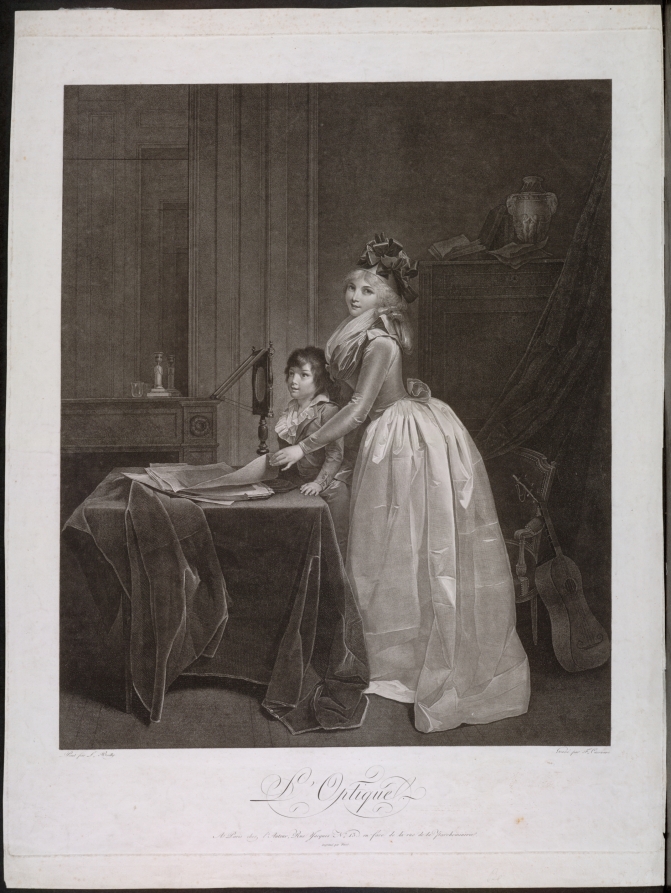
The Optical Viewer (c. 1793) is in the Cleveland Museum of Art collection. The museum's creator attribution is Frédéric Cazenave (French, active 1793–1843); Louis Léopold Boilly (French, 1761–1845).
The work and its context
The museum's open-access catalogue describes the work:
In this print, a fashionable woman and a boy look at prints through an optical viewer known as a “zograscope.” This form of entertainment, popularized during the 1700s, was equipped with a concave lens that made images appear three-dimensionally. Special prints called vues d’optiques, or “perspective views,” were designed to enhance the sense of three-dimensionality, creating an immersive experience. Most of the scenes depicted cities or memorable occurrences, allowing the spectator to witness important sites and events from the comfort of their own home.
Object facts
- Title: The Optical Viewer
- Date: c. 1793
- Creator attribution: Frédéric Cazenave (French, active 1793–1843); Louis Léopold Boilly (French, 1761–1845)
- Culture: France
- Type: Print
- Technique: Chalk-manner etching and engraving
- Dimensions: Image: 54.7 x 45.1 cm (21 9/16 x 17 3/4 in.); Platemark: 67.5 x 53.3 cm (26 9/16 x 21 in.); Sheet: 72.4 x 54.2 cm (28 1/2 x 21 5/16 in.)
- Collection: PR - Etching
- Department: Prints
- Accession number: 2001.15
A detail from the museum
Optical devices frequently appear in Louis Léopold Boilly’s work.
Collection credit
John L. Severance Fund
Further reading listed by the museum
- Wehn, James. “The 18th-Century Selfie: A new exhibition looks at the role of prints and drawings in pre- and post-revolutionary France.” Cleveland Art: Cleveland Museum of Art Members Magazine 56, no. 4 (July/August 2016): 8-9.
View the collection record
See the museum's photographs and full catalogue entry. Catalogue text is reproduced from the Cleveland Museum of Art's open-access data, with HTML formatting removed. This object and its supplied image are designated CC0.
Sources
More in Lifestyle
Keep reading