The prince being taken away for execution on the false complaint of the handmaiden, from a Tuti-nama (Tales of a Parrot): Eighth Night (c. 1560): Art, History and Details
The prince being taken away for execution on the false complaint of the handmaiden, from a Tuti-nama (Tales of a Parrot): Eighth Night at the Cleveland Museum of Art: c. 1560, gum tempera, ink, and gold on paper. Explore the work's context,
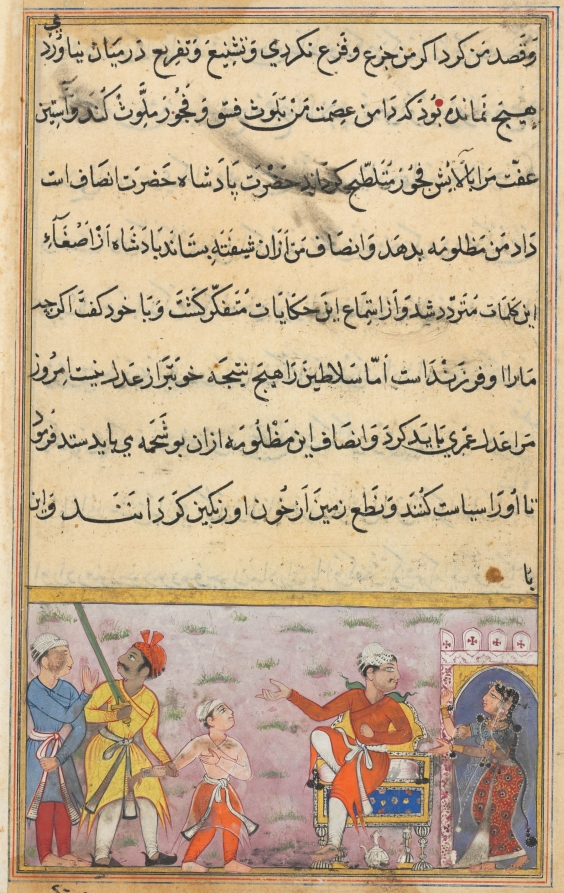
The prince being taken away for execution on the false complaint of the handmaiden, from a Tuti-nama (Tales of a Parrot): Eighth Night (c. 1560) is in the Cleveland Museum of Art collection.
The work and its context
The museum's open-access catalogue describes the work:
Embarrassed and angry that the prince rejected her advances, and worried that he will tell the king of her misconduct, the handmaiden preempts him by falsely accuses the prince of assaulting her. Since he has taken a vow of silence, he does not defend himself, so the king orders the prince to be beheaded.
Object facts
- Title: The prince being taken away for execution on the false complaint of the handmaiden, from a Tuti-nama (Tales of a Parrot): Eighth Night
- Date: c. 1560
- Culture: Mughal India, court of Akbar (reigned 1556–1605)
- Type: Painting
- Technique: gum tempera, ink, and gold on paper
- Dimensions: Painting only: 5.7 x 10.1 cm (2 1/4 x 4 in.); Overall: 20 x 13.9 cm (7 7/8 x 5 1/2 in.)
- Collection: Indian Art
- Department: Indian and Southeast Asian Art
- Accession number: 1962.279.56.b
A detail from the museum
The prince’s execution is prevented by the king’s viziers, who recount a series of moralizing stories.
Collection credit
Gift of Mrs. A. Dean Perry
Further reading listed by the museum
- Chandra, Pramod, and Daniel J. Ehnbom. The Cleveland Tuti-Nama Manuscript and the Origins of Mughal Painting. [Cleveland]: Cleveland Museum of Art, 1976.
- Nakhshabī, Z̤iyāʼ al-Dīn, and Muhammed Ahmed Simsar. Tales of a Parrot = The Cleveland Museum of Art's Ṭūṭīnāma. Cleveland: The Museum, 1978.
- Seyller, John. “Overpainting in the Cleveland T̤ūtīnāma.” Artibus Asiae 52, no. 3/4 (1992): 283-318.
View the collection record
See the museum's photographs and full catalogue entry. Catalogue text is reproduced from the Cleveland Museum of Art's open-access data, with HTML formatting removed. This object and its supplied image are designated CC0.
Sources
More in Lifestyle
Keep reading