The princess discovers the dead bodies, with heads severed, of her husband and his Brahman friend, from a Tuti-nama (Tales of a Parrot): Thirty-fourth Night (c. 1560): Art, History and Details
The princess discovers the dead bodies, with heads severed, of her husband and his Brahman friend, from a Tuti-nama (Tales of a Parrot): Thirty-fourth Night at the Cleveland Museum of Art: c. 1560, gum tempera, ink, and gold on paper. Explo
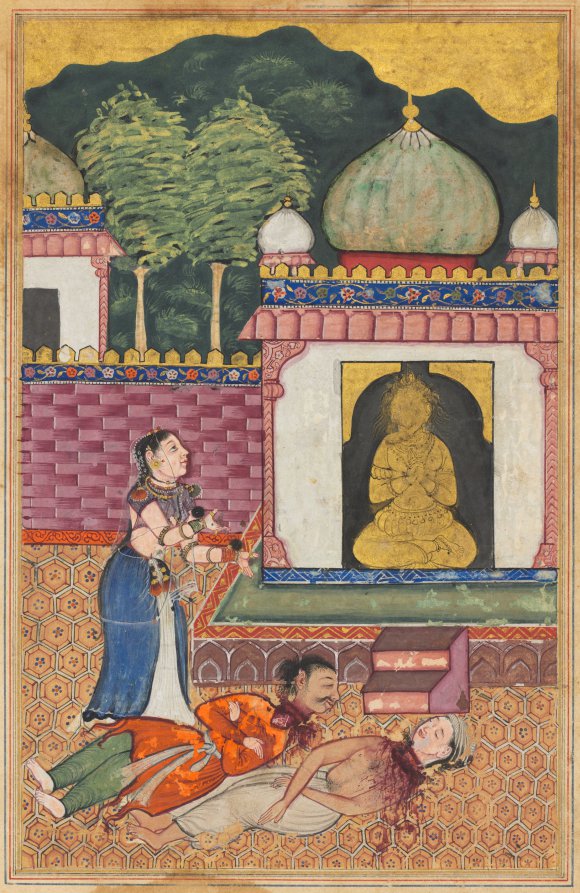
The princess discovers the dead bodies, with heads severed, of her husband and his Brahman friend, from a Tuti-nama (Tales of a Parrot): Thirty-fourth Night (c. 1560) is in the Cleveland Museum of Art collection.
The work and its context
The museum's open-access catalogue describes the work:
The frantic princess stands above the bodies of her husband, dressed in orange, and the Brahman. Both men have died by their own hand. They are miraculously resurrected after the princess places each head on the wrong body. Because of this mix-up, the men begin to fight over who should be considered the princess’s rightful husband.
Object facts
- Title: The princess discovers the dead bodies, with heads severed, of her husband and his Brahman friend, from a Tuti-nama (Tales of a Parrot): Thirty-fourth Night
- Date: c. 1560
- Culture: Mughal India, court of Akbar (reigned 1556–1605)
- Type: Painting
- Technique: gum tempera, ink, and gold on paper
- Dimensions: Overall: 20.3 x 13.4 cm (8 x 5 1/4 in.); Painting only: 17.7 x 10.3 cm (6 15/16 x 4 1/16 in.)
- Collection: Indian Art
- Department: Indian and Southeast Asian Art
- Accession number: 1962.279.229.b
A detail from the museum
A flag, which is a standard component of an active Hindu temple, was drawn for the tallest dome, but never painted.
Collection credit
Gift of Mrs. A. Dean Perry
Further reading listed by the museum
- Chandra, Pramod, and Daniel J. Ehnbom. The Cleveland Tuti-Nama Manuscript and the Origins of Mughal Painting. Cleveland, OH: The Cleveland Museum of Art, 1976.
- Seyller, John. “Overpainting in the Cleveland T̤ūtīnāma.” Artibus Asiae 52, no. 3/4 (1992): 283-318.
- Mace, Sonya Rhie, Mohsen Ashtiany, Catherine Glynn, Pedro Moura Carvalho, Marcus Fraser, and Ruby Lal. Mughal Paintings: Art and Stories: the Cleveland Museum of Art. London: D Giles Limited, 2016.
View the collection record
See the museum's photographs and full catalogue entry. Catalogue text is reproduced from the Cleveland Museum of Art's open-access data, with HTML formatting removed. This object and its supplied image are designated CC0.
Sources
More in Lifestyle
Keep reading